
Rewrite the DNA · Living edition
Chapter 4Judgment — Organizational Adaptive Insight
Great companies need and only need two capabilities: unified judgment standards, and unified context. Organizational judgment is the scaled form of personal adaptive insight. AI absorbs execution, leaving exactly these two to humans.
1. Two geniuses, two burial methods #
On August 18, 1992, Wang Laboratories filed for bankruptcy protection. It had been two years and five months since its founder An Wang died.
This company deserves the first half of the word "great." An Wang started with calculators. Before electronic calculators were undercut by Japanese manufacturers, he decisively pivoted to word processors. Both transformations landed at the right moment. The company maintained 40% annual growth for ten consecutive years. Revenue peaked at $3.07 billion in 1988, and headcount exceeded thirty thousand. Inside the company, An Wang was called "the Doctor." That title precisely describes its judgment structure: every important product and strategy call ultimately passed through that one mind. That mind worked very well—for nearly forty years.
Then it stopped working. On March 24, 1990, An Wang died of esophageal cancer. The company he left behind never made another major judgment correctly. Two and a half years later it was in bankruptcy court.
In the same era, another Chinese entrepreneur ran the opposite experiment. After 2001, Duan Yongping gradually stepped back from day-to-day operations. BBK split into three, evolving into OPPO, vivo, and BBK Education. He later said plainly: "I never remotely controlled OPPO or vivo." Without remote control, those companies repeatedly made the right calls over the next two decades: functional phones to smartphones, deep offline channels, premium breakthroughs. Their judgment style stayed remarkably consistent. Industry insiders could recognize it at a glance: "That's the BBK way."
Both founders had top-tier personal judgment. The difference is where judgment was stored. An Wang's lived in his head and was buried with him. Duan Yongping's was written into standards ("benfen" expanded at OPPO into four executable interpretations) and stored in the organization. People leave; standards keep operating. Personal judgment is luck; organizational judgment is capability. The former depends on whether that person is sharp today and still there tomorrow; the latter does not depend on any one person.
Personal adaptive insight cannot scale. How does it become a capability a thousand people can share?
2. The dual-capability model: the book's main frame #
Every argument that follows stands on this picture. The horizontal axis is unification of judgment standards: whether people (and AI) in the organization use the same ruler when making trade-offs. The vertical axis is unification of context: whether people (and AI) see the same picture of facts when judging. Two axes carve four quadrants:
- Lower left: legacy organization. Standards are not unified; context is not unified. Everyone judges from personal experience and acts on personally held information. "A hundred arrows flying in a hundred directions" lives here.
- Upper left: consensus without standards. Context is unified. Everyone shares the same read on the present; the atmosphere is good. But there is no shared ruler. Discussion runs hot; decisions follow volume or the boss. Typical feel: "We all agreed in the meeting; after the meeting, everyone did their own thing."
- Lower right: standards without consensus. Walls are covered with rules and values, but members see different fact pictures. Standards run on distorted context and produce precise errors. Nokia-style death lives here: the standards were fine; the information fed into them was beautified layer by layer.
- Upper right: AI-native organization. Same ruler, same picture. Judgment can happen at any node—frontline employee, newcomer, AI—because whoever judges uses the same ruler and sees the same facts.
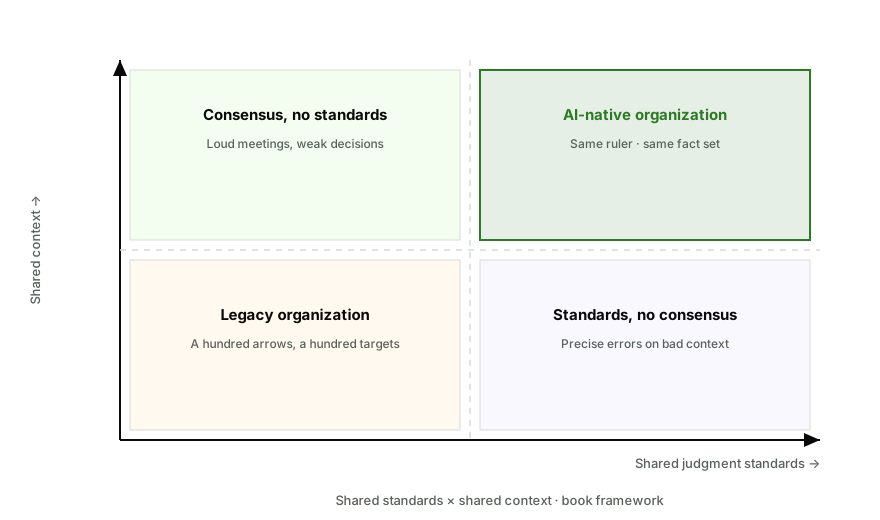
Figure: the book's main frame. Two axes, four quadrants; AI consumes the same two inputs.
In the AI era this picture gains a layer the old era lacked: your AI is also an employee, and it consumes these same two inputs. Give AI a judgment standard and it optimizes in that direction. Klarna's AI was fed "cost first." At 2.3 million conversations per month, it executed that mistake precisely. Give AI a context and it judges from that context. MD Anderson's Watson never shared the same medical-records system as the hospital. Klarna and MD Anderson both deployed AI. They recruited it into a lower-left-quadrant organization.
Strategy, product, marketing, and fundraising all matter. But they are outputs of judgment. Get standards and context right and the rest keeps getting produced. Get them wrong and every other function amplifies the error. Execution used to sit high on the "need" list and took the largest share. AI has taken it off the list. What remains is exactly these two. That is why the weight in the claim falls on only need.
3. The ruler itself: judge by value #
The dual-capability model's horizontal axis says "unified judgment standards." The natural follow-up: unified to what standard? There has to be a bottom ruler.
My answer: judge by value. Only ask what value a thing creates, for whom, and when it pays off. This is an engineering conclusion. Every problem has N solutions. N solutions must be ranked. Ranking requires a criterion. Emotion ("I don't like this plan"), identity ("the director proposed it"), busyness ("this team works the longest hours"), and short-term noise ("this feature has the loudest demand") can all serve as criteria—and only ranking by value ties directly to whether the organization survives.
Emotion, identity, busyness, and noise—four fake criteria, at least visible. The fifth, most hidden, is stance. Same act: infidelity. A stranger cheats: "That person has bad character." A friend cheats: you scold them lightly while already drafting excuses. When it is you: "Some situations really left no choice." Same behavior, three answers. The fact stayed put; the distance between judge and fact moved. When the ruler is not written down, stance becomes the ruler. Worse, the person switching rulers feels nothing. In all three judgments, each time they are sure they are objective. Social psychology calls this actor–observer bias (Jones & Nisbett, 1972): explain others' behavior by character; explain your own by circumstance.
In organizations this plays out daily. Only "infidelity" becomes delay, overrun, lost deals. Another team's delay is poor execution; your team's delay is objective difficulty. A rival's price cut is predatory; yours is strategic concession. Everyone already carries a pocket ruler that stretches with stance—and measures with a clear conscience. That pocket ruler is the real enemy of "judge by value." Writing standards down pulls the ruler out of every pocket and nails it to the wall. Inheritance is a side effect; the deeper reason is the pocket ruler. A ruler nailed to the wall uses the same marks on others and on yourself.
The ruler is most often misused on time. Value has two accounting periods. Short-term value usually concerns cash, survival, limiting resources. Long-term value concerns capabilities, standards, talent, trust—things that compound. "Judge by value" requires both in one coordinate system, not picking a side. Using "long-termism" to dodge short-term survival and using short-term revenue to burn long-term trust are the same error: only one accounting period is counted. Wang Laboratories in its late period made both errors. It refused equity dilution and loaded debt—long ruler on a short-term survival account. It announced fourteen products in one launch; most never shipped—long-term credibility traded for short-term buzz.
The ruler must reach people. What is ultimately created and accumulated is value. Calendar fullness and title height do not measure it. In practice, evaluating someone means what their work leaves behind: how many verified standards added? how many reusable assets? That is what the gene swap "execution worship → judge by value" looks like on judgment.
"Judgment standards" are a three-layer judgment system:
- Value ranking (why): the bottom sort key—judge by value, just covered.
- Thinking framework (how to think): process rules for how conclusions must be derived and evidenced. First principles, two-sided samples, medians in statistics live here. It governs not which option wins but how options and conclusions are produced.
- Decision rules (what to choose): trade-off clauses in concrete scenarios. Cash flow before pretty reports; benfen's four lines; no meeting without a demo.
All three layers meet the definition of a standard (writable, borrowable, verifiable, inheritable). So when the dual-capability model's horizontal axis says "unified judgment standards," it means this whole system unified. Manufacturing long had an isomorphic split: process standards govern how work is done; acceptance standards govern outcomes—both called standards. Organizations missing the middle layer most often show aligned values and decision rules present, yet two teams reason by completely different methods and reach irreconcilable conclusions. Same ruler, different process—outputs still fight.
4. From four actions to two capabilities: organizational translation of adaptive insight #
Four actions work fine in one person. He finds the gap, borrows, judges transfer, verifies. The problem is where the output goes: verified standards sit in that person's head. Person two hits the same problem and runs all four again. In a thousand-person organization the same standard gets rediscovered a thousand times—or worse, a thousand people borrow a thousand conflicting standards, each verifies, each is certain. The stronger personal adaptive insight, the more hidden the waste, because every local pocket looks smart.
The dual-capability model gives the four actions organizational exits and entrances:
- Unified judgment standards (horizontal axis), carrying actions two and three: whatever standard anyone borrows and verifies enters the public standard library, harmonized, then issued to all people and all AI. One person's tuition, a thousand people's waiver.
- Unified context (vertical axis), carrying actions one and four: where the standard gap is, which standard is under test, which was just falsified—this information enters shared context. Finding gaps no longer depends on one person's sharpness; correction no longer depends on one person's candor.
This translation needs a gate: not every experience qualifies for the library. Only experience that has been compared, verified, reflected on, and can state its transfer conditions upgrades to organizational judgment. Otherwise the standard library becomes an empiricist warehouse issuing unified error.
Personal adaptive insight produces standards; organizational judgment stores, unifies, and compounds them. The former is the mine; the latter is the grid. Without the grid, no matter how much ore, only the miner's headlamp lights up.
5. Five metrics: testing whether judgment is a real asset #
"Our company has judgment" cannot be falsified, so it carries no information. For judgment to become a manageable asset, it must first become testable. Five metrics:
- Win rate: Can you win key competitions across cycles? Winning once may be luck. Across cycles the environment turns several times and you still win. Luck is not that patient.
- Correction rate: After failure, how fast and at what cost do you find error, revise judgment, and resume action? This metric is more honest than win rate because it can only be measured in failure. An organization that never fails has no correction-rate data—only risk not yet cashed in.
- Replication rate: Leave the founder or top leader—can the organization still produce people with recognizably similar judgment style? Direct test of whether judgment lives in the organization or in a person.
- Migration rate: Same judgment frame, new industry, region, or task—does it still produce results? Migration means the organization holds a standard; no migration means it holds scene-specific experience.
- Spillover rate: Has the outside started actively using your language, frames, judgment standards? Distinct from brand fame: fame is "others know you"; spillover is "others think with your ruler."
The first two test judgment quality: winning, affording error. The last three test whether judgment escapes the individual and compounds. When scoring each 1–10, one discipline: do not average. Averaging lets a replication rate of 1 look respectable on high win rate. Read the median first, then stare at the lowest item. The lowest is almost always where judgment fails to compound. Wang Laboratories might score 8 on win rate and 1 on replication. That 1 is the whole story of August 18, 1992.
6. Three sample halls: compare mechanism, not scale #
Three positive samples of judgment as asset. The Chinese Communist Party is a very large political organization. Duan Yongping's influence circle is an entrepreneur network bred from shared culture. Musk's enterprise cluster is a person-centered cross-company network. They are not the same species, so this section does not compare scale, performance, or "who is strongest." The only question is through what mechanism the judgment of a few becomes organizational asset.
Duan Yongping's influence circle—this chapter's load-bearing wall (full lineage verifiable). Chain: 1995 Duan leaves Subor, founds BBK; among six mid-level leaders he took were Chen Mingyong, Shen Wei, Jin Zhijiang; 2001 BBK splits three ways; 2004 Chen founds OPPO on the audiovisual business. The key assetization move came 2004–2005. OPPO expanded "benfen" from one word into four executable interpretations: isolate external pressure and temptation; when problems arise, seek responsibility in yourself first; do not take advantage of others; benfen above honesty (do what should have been done even without a promise). Essence: personal character translated into a judgment algorithm. How to rank temptation, who to examine first when something breaks, where to draw the line—all executable, testable, transmissible to the next person.
Four of five metrics pass (same-caliber event list for correction rate not yet complete; boundaries section notes limits). Win rate: functional, smartphone, and premium cycles—all still at the table. Replication rate: Chen, Shen, and Jin each helm independently; judgment style recognizably consistent. Huang Zheng calls himself "fourth disciple of the next generation"—Duan has not formally acknowledged discipleship; marked here as self-description. Migration rate: same standard set from educational electronics to phones to e-commerce. Spillover rate: "benfen" and "dare to be behind the world" have become industry language. A strong individual can win once; a strong organization can replicate how it wins.
Musk enterprise cluster—mechanism list (mechanisms only; bilateral verification of effect data still in progress). Four identifiable mechanisms. First, first principles as unified thinking framework—the judgment system's process standard: reject unverified industry convention; re-derive all costs from physical bounds. Thousands of engineers share one reasoning craft, not one slogan. Second, extreme goals compress context: "cut launch cost two orders of magnitude" synchronizes trade-offs for thousands in one sentence. Third, high-frequency controlled failure as correction mechanism: exploding rockets on the test schedule, not accidents. Fourth, mission filters talent as replication tool: trade management layers for goal concentration. All four point to the same effect: small core teams carry tasks once reserved for giant organizations. Judgment density replaces headcount density.
Chinese Communist Party—scale limit sample. Research boundary first: only how judgment standards unify, how context is manufactured at scale, how correction happens, how organizational language spills outward. Publicly published primary sources only. No political stance or historical evaluation. Mechanism description without value judgment. Its value here is scale: one value ranking and organizational language spanning more than half a century, tens of millions of members, multiple major corrections—yet a unified judgment frame and context-manufacturing capacity persist. This shows the dual-capability model has no scale ceiling.
Scale differs by five orders of magnitude; the shared skeleton is the same: stable value ranking, explicit judgment standards, unified context, distributed execution, fast correction. That is the strongest evidence that judgment is organizational asset, not personal gift: if it were gift, the same skeleton could not grow in such different containers. The argument does not rest on any single sample. Remove any one hall whole and the skeleton still stands.
7. Wang Laboratories on the dissecting table: full pathology of strongman dependence #
The popular cause of death is "missed the PC." That stops at symptoms. Missing the PC was one judgment error. The real cause was no mechanism in the organization to correct "the Doctor's" errors.
Three lesions, each with multi-source detail:
Lesion one: succession by blood, not by standard. In 1986, against senior management's collective opposition, An Wang appointed his thirty-six-year-old son Fred president. John Cunningham, an eighteen-year veteran who had been president, resigned. Core executives followed. The signal: in An Wang's judgment system, "my judgment can continue through my bloodline." Judgment was treated as legacy. Legacy passes by inheritance, not replication. Contrast Duan Yongping: BBK successors were mid-level leaders screened and trained by the same standard. Zero blood tie; judgment style consistent enough for the industry to recognize.
Lesion two: standards never left that mind. An Wang's judgment is beyond dispute. The timing of both pivots was textbook. Yet for forty years that judgment was never written in testable, inheritable form. Strategy swung with personal intuition. In 1983 the company announced fourteen hardware and software products; most never delivered; credibility damaged. Dedicated word processors were copied by PCs running cheap software; price was undercut. The organization had no public ruler to ask "why hasn't the Doctor pivoted yet?" Judgment lives in organizational standards. The kind in a head sleeps every night and one day sleeps forever.
Lesion three: even correction was personal. Fiscal 1989 loss: $424 million. An Wang made one fully correct correction: fired the president. The president was his own son. The timing was weeks after esophageal cancer surgery. Often told as tragedy; the mechanism is what stuns. The only person authorized to correct bad judgment was the person who made it. The entire correction mechanism was a dying old man's self-override. After his death the company lacked even that. FY1990 revenue still $2.5 billion, loss $715.9 million. Bankruptcy August 1992, liabilities $550 million.
The old gene to replace appears here: strongman dependence. It deposits organizational judgment in a few strong people. It substitutes loyalty to them for execution of standards. The stronger the strongman, the more comfortable this gene. An Wang's mind worked forty years, well enough that no one—including himself—felt need for standards that could run without him. If judgment lives only in heads, the founder's obituary is the company's obituary. Replace it with judgment assetization: distill into standards, settle into context, let everyone (and every AI) inherit.
8. Boundaries of the claim #
Unified judgment standards are not one-voice rule. What unifies is sort key and boundary: what counts as value, priority when values conflict, what must not be done. Not every concrete answer. The better standards unify, the more execution can distribute. Duan Yongping's "never remotely controlled" works because remote control is unnecessary—the ruler is already in everyone's hands. One-voice rule is a form of strongman dependence. It is the opposite of this claim, not its extreme.
Five metrics are rulers. Scoring your own organization, absolute numbers matter less than spread across the five. Cross-organization comparison compares whether mechanisms exist, not score levels. Win rates have no comparable caliber across industries.
Sample quality, stated plainly. Duan Yongping circle lineage and doctrine texts fully verifiable. Same-caliber failure and correction event lists (OPPO early pivot setbacks, vivo smartphone hesitation) not yet complete—half the survivor-bias homework remains. Musk cluster this chapter cites mechanisms only; bilateral effect data under verification. CPC sample primary-source collection just started. Evidence structure: Duan circle (positive) and Wang Laboratories (negative) as two full load-bearing samples; other two halls as supporting evidence. Load-bearing walls hold the claim; fuller samples would make it sturdier. Account recorded here, not hidden.
What to Do Monday Morning (principal-leader view) #
One sheet, two tests, forty minutes:
Test 1: Standard audit. Write the company's three most recent important decisions. For each, four questions: What standard was the basis? What value for whom, when payable? Which scarce resource consumed? Did short-term gain damage long-term value? Decisions you cannot write a standard for are live evidence judgment is not yet assetized. That decision currently sits in someone's head.
Test 2: Five-metric checkup. Win rate, correction rate, replication rate, migration rate, spillover rate—each 1–10. Discipline: no average; median first for overall level, then lowest item. Ask of the lowest: if I take a one-year sabbatical starting tomorrow, what score does this item become? After scoring you will know whether your company looks more like the BBK lineage or Wang Laboratories in 1989. That year its revenue was still $3 billion. Everything seemed fine.
Individuals and teams can aim replication rate at themselves: among people you have led, how many kept judgment level after leaving you? Managers whose answer is zero, however good the numbers, are becoming their team's An Wang.
Chapter Acceptance Self-Check (against chapter acceptance standards) #
- Claim restatable in one sentence ✓, and as inference from core claim (adaptive insight solidified into organizational capability—structure and test).
- Whiteboard framework figure ✓ (dual-capability four-quadrant figure inserted + organizational strength five metrics).
- External comparison and data ✓: winner side Duan Yongping influence circle (lineage verified, load-bearing wall) + Musk (mechanism level, quality noted) + (boundary-limited supporting evidence, quality noted); loser side Wang Laboratories (multi-source verified); five-metric scoring explicitly "no average, read median and lowest item"; actor–observer bias (Jones & Nisbett, 1972).
- Twelve quotable-line candidates ✓.
- "What to Do Monday Morning" two tests + personal note ✓.
- Fluency ✓: whole-sentence rewriting and English breath under current prose-standard.