
Rewrite the DNA · Living edition
Chapter 6No Standard, Stop Execution
Standards are the solidification of judgment and the interface through which organizations issue instructions to AI. Execution without standards is not fast—it is false execution.
1. Two Eras of a Bowl of Noodles #
Liuzhou people have been eating snail noodles for decades. Which shop's broth hits right, how pungent the sour bamboo shoots should be, how chewy the rice noodles ought to feel—consensus on all of this lived in the alleys long before anyone wrote it down. But that consensus lived only on the chef's hands and the diner's tongue. Consensus that lives there has one fatal property: it cannot be copied. A master needs three years to train an apprentice; leave Liuzhou and the flavor drifts; bag it and it spoils. For decades the industry looked like this: nearly five thousand brick-and-mortar shops nationwide, each running on feel.
In June 2015 the Liuzhou municipal government set up a working group to draft local standards. In May 2016 the Local Food Safety Standard for Liuzhou Snail Noodles took effect—ingredients, packaging, physical and chemical indicators, microbial limits—one bowl of noodles turned into testable clauses, item by item. One detail in those clauses is worth remembering: rice-noodle moisture content is fixed at 14%. Higher moisture breeds mold; lower moisture snaps the noodle. The number entered the standard only after repeated trials, lab testing, and input from producers on what their lines could actually hold. Every number in a standard should be a verified judgment. A number that merely looks professional is decoration.
Then the industry curve kicked in. Bagged snail-noodle producers went from 1 in 2014 to 113 in 2020. Bagged sales revenue hit 10.994 billion yuan in 2020, up 75.74% year on year, and export value was thirty-five times the prior year. In 2021 the full-chain sales revenue reached 50.16 billion yuan, and annual bagged parcel volume passed 100 million pieces. The timeline carries causality. Flavor consensus had existed for decades and the curve stayed flat. The moment consensus was written into a standard, the curve turned steep. From that moment, the judgment of this bowl—what counts as qualified—could leave the master's hands for the first time and run on factory lines, QC instruments, and producers on the other side of the ocean.
In most companies the word standards smells like bureaucracy—files, stamps, process. Its real identity is something else. Standards are not bureaucratic paperwork. They are how judgment gets stored.
2. The Triple Identity of Standards #
Inside this book, standards carry three identities, each more valuable than the last.
First: solidified judgment. Judgment is organizational capital, but gaseous judgment—the intuition living in one person's head—is open risk, not capital. Wang An Computer made that point with bankruptcy. Judgment completes the phase change from personal capability to organizational asset only when it is distilled into solid clauses: under what conditions, with what trade-offs, where the qualification line sits. The 14% in snail noodles is one such phase change. The master's fingertip sense became a number any inspector can execute.
Second: the organization's compound-interest vessel. A verified standard pays back its verification cost the first time it runs. Every use after that is pure gain, and the user does not have to get smart all over again. Individuals borrow standards through adaptive insight; organizations lean on standard libraries to skip repeated groping. Standards are therefore the one asset in an organization that gets cheaper the more you use it. People tire and judgment wobbles. Standards do not.
Third: AI's instruction interface. This is the new crown standards wear in the AI era, and the second half of this chapter's claim. Everything you exchange with AI—prompts, evaluation rules, context files, workflow definitions—is standards in disguise. You are telling it what counts as good, what is forbidden, and in what order to rank options. The quality of the standards you give AI is therefore the ceiling on what AI can produce. Klarna already showed the reverse: feed AI a wrong standard like "cost first," and AI amplifies it with flawless execution. In the old era, vague standards let human employees quietly patch with common sense, and bad standards could run sick for years. AI does not patch. It amplifies. SOP used to be management prose for humans; now it is instruction issued straight to machines. When execution is free, standards are the only control you still have over execution.
3. The Rule of This Chapter: No Standard, Stop Execution #
Once the triple identity is set, the rule surfaces on its own. Execution is free and judgment is scarce, so the most dangerous state for any task is high-speed execution with no standard behind it. Free execution multiplied by absent judgment equals maximum-efficiency rework. The feel of unstandardized execution is busyness—a growth illusion at the personal layer, and the same at the organizational layer. The operational clause is one sentence:
When you find a task has no standard, stop executing immediately; find, borrow, or build a standard first, then resume.
Three operational questions, answered in order:
Who may call a stop? Any discoverer. The rule goes wrong fastest when stop authority becomes a rank privilege, because that stacks approval on top of unstandardized execution. The right design makes stopping an obligation: anyone who finds themselves or their team executing without a standard reports it, and that report is the stop. A manager's job is to respond to the stop, within an agreed window, by organizing borrowing or building of a standard—not to approve it. An organization that cannot stop has broken brakes, however fast it executes.
What do you do while stopped? The sequence is fixed: borrow first (who has done this before? bring the standard and its boundary of applicability together), then verify (do the migration conditions hold in our scene?), and only then build (if you cannot borrow or verification fails, create a new standard with the cheapest experiment you can run). Do not scramble this order. Build before borrow is paying twice; borrow without verify is how Johnson died at JCPenney.
When do you resume? When you have an executable standard. The acceptance test for executable: a newcomer (or AI) following it can produce results at the same waterline. Anything below that bar is a mood, not a standard.
Stopping is not stalling. When execution was expensive, stopping cost real money. When execution is free, stopping to find a standard is the cheapest execution move you can make. You lose a few days of fake progress and buy back the freedom not to finish the mistake.
In June 2026 our Shenzhen office moved. I wanted to turn one 15-square-meter room into a meeting space—budget roughly ten thousand yuan, target experience in one line: the comfort of a single armchair plus the formality of receiving guests. Before any work started I looked for a standard: how do both experiences hold in fifteen square meters? Who has done it? What counts as done? Three days of search turned up no mature answer to borrow. We paused. That room is still empty.
Does a ten-thousand-yuan project deserve this treatment? Open the ledger. The cost of stopping is three days of search plus a temporarily vacant room. The cost of not stopping is ten thousand yuan on a plan where nobody can say what "done" means, with high odds of paying again. The real reason sits outside the ledger. Organizational DNA is default behavior that runs even without supervision. When the principal leader can stop on a ten-thousand-yuan item, "no standard, stop execution" grows into organizational muscle. When small things always start with "just get going," nobody will believe a sudden demand to stop and find standards on a ten-million-yuan decision. Small things are the practice ground for DNA. Big things are only its exam hall.
4. The Standards Engine: Cycle Pump and Ladder #
The standards engine is a cycle pump: judgment (gaseous) → distillation → standard (solid document) → dispatch (to people and AI) → execution → data feedback → standard iteration. The inlet draws the judgments that happen in the organization every day; the outlet pushes out a standard library that gets sharper over time. At the personal layer there is a straight-line versus fork contrast: same diagram—swap "one person's path" for "a thousand people's paths" and multiply the cost of every fork by a thousand.
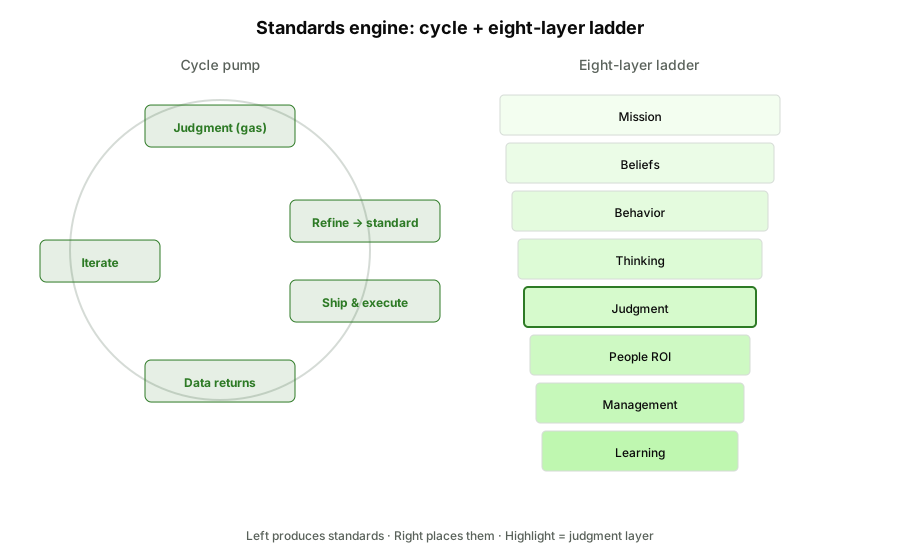
Figure: the pump answers how standards are produced; the ladder answers where they live. Highlight = judgment layer.
The pump answers how standards are produced. One question remains: which standards does an organization actually need? The answer is an eight-rung ladder:
- Mission answers why we exist: use AI to raise the level of all humanity.
- Belief answers what we hold over the long term: human–machine collaboration is humanity's future.
- Conduct standards constrain how we act: treat people with honesty.
- Thinking standards govern how conclusions get produced: borrow before create, two-sided samples, report medians not means, first principles—and this book's Clarity Method (expand your own options) and Interference Method (narrow the other party's options). Those thinking frames all live on this rung.
- Judgment standards govern trade-offs: judge by value.
- People-investment standards test whether human capital compounds: all-staff ROI greater than 1, verification window shifting by stage.
- Management standards govern how decision rights get allocated: instruction → guidance → consultation → delegation → empowerment.
- Learning standards govern how the system gets corrected: reflection (examine oneself thrice) + the Feynman technique.
These eight sample clauses are the master organizational-standard table my company bioby.ai runs every day, not fictional templates written for the book. The sentence behind each rung is what our people and AI actually execute. Printing our operating-system text in the book means this stack faces two tests at once: your scrutiny, and our own operating results.
The eight rungs form a causal chain, not a wall of parallel slogans: mission sets direction, belief sets long-term assumptions, conduct standards constrain means, thinking standards govern how to think, judgment standards govern trade-offs, people-investment standards test whether value covers limiting resources, management standards allocate decision rights, learning standards keep correcting everything above. The split between thinking standards and judgment standards: process standards govern the process, acceptance standards govern the outcome. One governs how conclusions are produced, one governs how options get ranked, and between them sits the line between thinking and choosing.
Two usage notes. First, the ladder is not built in one pass; what you see here is the panorama. Second, the word values does not get its own rung, because values that never enter judgment, management, and learning processes are adjectives hung on a wall. The bottom five rungs are values in executable form.
5. What Deserves to Be Written as a Standard: Build on Invariants #
Before the standards engine starts, there is a site-selection problem. Hundreds of judgments happen every day. Which ones do you solidify first? An engine pointed at the wrong object efficiently manufactures waste paper.
The site-selection principle has a primary source. For thirty years Bezos was asked what will change in the next ten years. His answer: that is the wrong question. "I almost never get asked what won't change in the next ten years—and the second question is actually more important, because you can build a strategy on things stable in time." Amazon retail's three invariants: customers want lower prices, faster delivery, more selection. "I can't imagine a customer ten years from now saying, I love Amazon—I just wish you'd charge more and deliver slower." He added a line quoted less often but just as sharp: "You don't need much research for this—these things are big and fundamental; you know them yourself."
So standards should be built on invariants first. Standards on invariants do not need constant rewrites; verification cost is paid once, and compound interest runs for years. Amazon's three invariants have governed resource allocation for twenty-five years. The annual shareholder letter that gets reprinted every year is their capital version. To find your invariants, use Bezos's test: if you cannot imagine a customer asking for the opposite ten years out, it qualifies. What happens when standards sit on variables instead is the next specimen.
6. Loser Specimen: The Company That Resets Every Two Years #
Qudian Group listed on the NYSE in October 2017; market cap once topped $10 billion. Campus loans and cash loans supplied the first pot of gold and the first verified capability set: online acquisition, risk models, and the operating system for disbursement and collection.
Then regulation tightened, core business squeezed, and Qudian pivoted. In 2018 it launched Dabai Auto (auto new retail) and halted sales in May 2019. In 2020 it ran Wanlimu (luxury e-commerce) and Wanlimu Kids (education), each dying within about a year. In 2022 it pivoted to prefabricated meals with a loud launch and received two NYSE warnings for trading below $1 that same year. Market cap sat near $290 million—roughly 97% gone from peak.
Qudian did not die of picking the wrong trend. Each trend it picked was plausible on its own. It died because every pivot discarded all standards settled on the prior leg and restarted from zero. Acquisition standards, risk standards, operating standards—none were asked which parts sat on invariants and could migrate to a new scene. Against the four adaptive-insight moves, this is organizational absence of "judging migration conditions": leaving with no standard at all, rather than borrowing the wrong one. Bezos's three invariants have not changed in twenty-five years; Qudian's scoreboard changes every two years. Trends shift, and every trend still has its own scoreboard. Standards built on trend variables reset organizational judgment every two years.
Put Qudian beside snail noodles and the contrast stings. A street snack, once consensus was written into a standard, grew from one company into a 50-billion-yuan industry. A ten-billion-dollar company, never solidifying standards, pivoted four times back toward zero. The transferable standards the business deposited were the asset, not the business itself. Losing standards costs more than losing a business. Only the bill arrives slower.
7. The Standard for Standards: Why the Median Is Iron Law #
On the thinking-standards rung of the eight-rung ladder, one full example answers what standard you use to write standards, and whether the recursion ever ends.
The example is the statistical iron law that recurs in this book: report the median, not the mean. The reason lives in organizational behavior, not in a math textbook. Means get hijacked by outliers, and organizational decisions get hijacked most easily by star cases. A sales team with ¥800,000 average per capita might mean ten people each near ¥800,000, or one star at ¥5 million dragging nine at ¥300,000. The mean gives the same number for both shapes; the median honestly reports the gap between ¥800,000 and ¥300,000. Personnel decisions on the mean set targets from a star's phantom; on the median you see the organization's true waterline. The mean lies because it fears outliers. The median is honest because it recognizes the majority.
That rule closes the recursion question. The standard for standards is the thinking-standards layer. It governs how every standard is produced—how you gather evidence, count, verify—and it stays few and stable (borrow before create, two-sided samples, median—you can count them on one hand). Recursion stops here. A foundation does not need another foundation.
8. Boundaries of the Claim #
The claim needs boundaries, or it becomes a new bureaucracy.
First, not every judgment deserves solidification. The standards engine's capacity is also a limiting resource. Solidify only high-frequency judgments where error cost is high: the steps with the most rework, trade-offs that repeat, handoffs AI takes over. Low-frequency, low-cost, highly situational judgments stay with live human judgment; forcing standards on them costs more than it saves. A healthy standard library is measured by citation rate, not by count. A standard nobody cites is waste paper in uniform.
Second, standards go stale, and the rule itself carries amendment clauses. The last rung of the eight-rung ladder (learning standards) exists to correct the seven above. Bezos's "invariants" are not a claim that nothing ever changes—outside the three invariants, Amazon's specific plays have rotated countless times. Qudian's lesson is the missing standard-migration audit when direction changes: which standards sit on invariants and should travel, which sit on old-scene variables and should stay. Changing direction is fine; running naked is not.
Third, sample quality, stated plainly. Snail noodles are a government-led industry-standard specimen, and they are not the same shape as an internal standards engine. This chapter takes only the mechanism that consensus, once solidified into a standard, can be copied at scale. It does not credit industrial policy entirely to the standard (industrial parks, logistics, e-commerce tailwinds all sit in the curve). The internal "stop execution" trigger (, the meeting room in Section 3) is my own account—take it at a discount. Another gap, marked honestly: an enterprise case of a company with SOP culture turning SOP into an AI interface is not yet filled; still looking. This chapter's load-bearing structure is the triple-identity derivation plus the Qudian–snail-noodles contrast. Filling the gap will add depth without changing what carries the weight.
What to Do Monday Morning (principal-leader view) #
Three steps, under one hour:
- Find the lesion: Pick the work type with the most rework in your company and ask one question: does it have a written qualification standard? If not, write it today; if you cannot write it, the judgment for that work has not been distilled yet. That is the meeting worth ten rework postmortems.
- AI touchstone: Feed the written standard straight to AI and have it produce one pass to spec. AI output quality is a mirror of standard quality. Human employees quietly patch vague standards with common sense; AI will not—it amplifies every ambiguity back at you. Revise the standard, feed again, until AI output makes you say "qualified." Only then is the standard finished.
- Set the rule: Tell management the stop rule: anyone who finds unstandardized execution reports it and that report stops work; managers respond within the agreed window. Pair it with: stopping is not punished; hiding and not stopping is. Week one you will likely get a burst of stop reports—do not panic. Chaos did not increase; existing chaos became visible for the first time.
Individuals and teams can use the same AI touchstone: when AI's work always disappoints, do not blame the model first—read your prompt as the standard you wrote. How many testable qualification conditions does it contain? Most people find they gave AI wishes, not standards.
Chapter Acceptance Self-Check (against chapter acceptance criteria) #
- One-sentence claim restatable ✓, and it follows from the core claim (adaptive insight must be written as standard to be reused → unstandardized execution equals zero-judgment execution).
- Whiteboard framework diagram ✓ (standards-engine cycle pump and eight-rung ladder figure inserted).
- External contrast and data ✓: positive Liuzhou snail noodles (government documents and industry data verified, scope boundaries stated) + S3 Bezos invariants (HBR 2007 + re:MARS 2019 primary sources verified); loser Qudian (financial-report level verified); meeting-room instance in Section 3 (self-report quality stated in claim boundaries); "SOP → AI interface" gap marked honestly.
- Twelve quotable-line candidates ✓.
- "What to Do Monday Morning" three steps + individual note ✓.
- Fluency ✓: whole-sentence rewriting and English breath under current prose-standard.