
Rewrite the DNA · Living edition
Chapter 11A New Allocation of Time: Evolving Personal Rhythm
Give 1–2 hours a day to short-term urgency (money-related) and 6 hours to long-term importance (value-related). Time is the individual’s only limiting resource; the allocation is personal strategy.
1. An almost blank calendar #
In January 2017, on Charlie Rose’s set, Buffett handed his paper calendar to the host. Rose flipped page by page to a week in April and found three appointments. “By April, maybe there will be four,” Buffett added.
Gates sat beside him and explained what that calendar had done to him. He used to fill every minute, believing that was the only way to work, until Warren showed him the pages. What he learned boiled into two lines: you control your time, and the priority of sitting down to think may sit far above a normal CEO’s default; a full schedule is not proof of seriousness. Buffett’s reason underneath was simpler. People want your time, and it is the only thing you cannot buy. He could afford almost everything. He could not buy time.
The belief underneath most calendars is that busyness is dedication, and a packed week proves worth. Two people at the top of the world’s wealth tables have been running a different experiment. One has worked for decades from a nearly blank calendar. The other now says that packing every minute was a mistake.
Standards, context, decision rights, and talent structure all sit at the organization layer. The organization’s smallest unit is still your own day. Find the limiting resource and pour the best resources into it. For the organization, that resource is judgment. For the individual, it is time. Judgment, however strong, becomes output only through time, so how you allocate time is personal strategy. Your calendar is your strategy; everything else is publicity.
2. Collective portrait of the old ratio: a day cut into three minutes #
Most people’s days already have a ready portrait. Microsoft’s Work Trend Index 2023, built on a cross-national survey of thirty-one thousand people plus Microsoft 365 telemetry, found that employees spend on average 57% of time communicating (meetings, email, chat) and 43% creating. Sixty-eight percent say they lack enough uninterrupted focus time in the workday. Heavy meeting-goers spend 7.5 hours a week in meetings, and Teams meeting volume rose 192% from early 2020.
The grain of interruption is more startling than the ratios. Gloria Mark’s team at UC Irvine ran a blunt field study: thirty-six knowledge workers tracked for three full days, every action timed to the second. A single matter lasts on average 3 minutes and 5 seconds before interruption or switch, formal meetings excluded. On that grain, a typical knowledge worker’s day is more than a hundred three-minute slices.
When people cite Mark, almost every article adds another number: “It takes 23 minutes and 15 seconds to regain focus after an interruption.” Checked against the original, that is folklore. The study said interrupted work was picked up again after an average of 23 minutes and 15 seconds, with about two other tasks inserted in between, and 81.9% of interrupted work resumed the same day. An interval to pick up was retold as a cost to refocus—same digits, wrong meaning. That the figure travels so widely proves one thing: a precise number is the most efficient distractor, whether or not it is correctly understood. The only safe habit is to quote data from the primary source.
After the correction, the raw data still convicts. Fifty-seven to forty-three, a switch every three minutes: that is the collective portrait of the old ratio. When execution was expensive, such a day barely made sense. Information moved by human bodies; without you present, work stalled; and busyness was imposed by the system. After execution becomes free, AI takes execution and hauling, and the nature of that day changes. A day filled with urgencies spends the scarcest time on the most oversupplied work, and yesterday’s virtue becomes today’s waste.
3. The new ratio: one or two hours for money, six for value #
Our internal time standard is one sentence: short-term urgent, 1–2 hours a day, money-related; long-term important, 6 hours a day, value-related.
Money-related work bleeds today if left undone: cash flow, customer delivery, sudden failures, current collections. It is urgent and it does not add value—you stop the bleeding, and the organization is no stronger. Value-related work permanently raises organizational capability. Counted out, there are four kinds: set and revise standards; the two learning tools of reflection and Feynman; maintain shared context; lead people along the decision-rights ladder. None of it rings an alarm if skipped today, and each kind compounds.
Picture two time bars. The upper is the new ratio: 1–2 hours labeled “money,” 6 labeled “value.” The lower is a typical executive’s present: 7 hours firefighting, 1 hour thinking—two bars inverted. Transformation is nothing but flipping the lower bar into the upper.
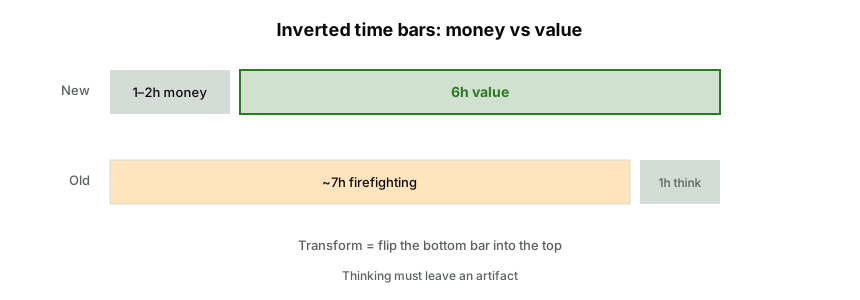
Figure: transform by flipping the bottom bar into the top; thinking must leave an artifact.
Some will call this a rich person’s privilege, impossible when business wraps you. Bezos offered a testable rebuttal in a 2018 interview with the Economic Club of Washington. His day: morning “puttering” (paper, coffee, breakfast with the kids); first meeting at ten; brain-burning “high-IQ meetings” all before lunch—“by 5 p.m. I’ll say: I’m done thinking today; try again at 10 tomorrow”; eight hours of sleep, non-negotiable. What holds the rhythm is his definition of the job: “As a senior executive, you get paid to make a small number of high-quality decisions. Your job is not to make thousands of decisions every day. If I can make three good decisions a day, that’s enough.” He also ran the arithmetic. Four hours less sleep buys 33% more “production time” and thirty-three more decisions, but quality falls with fatigue, so trading quantity for quality is a losing deal. Buffett pushes the same logic to the limit: three good decisions a year, he says, would be fine.
What the rebuttal actually tests is a structural claim. Decision quality and transaction volume demand opposite time structures: transactions reward a full calendar, and judgment rewards blank space. The closer your role is to judgment—and every role left after collapse is a judgment role—the more your calendar should move toward blank.
That 1–2 hours of money time has its own discipline, or it expands like gas and fills the day. First, batch. Handle bleeding points in fixed windows—for example, half an hour each morning on cash flow and delivery exceptions—rather than staying on-call all day. On-call processes other people’s schedules more than it processes urgency. Second, acceptance stops at hemostasis. Money time’s output check is “bleeding stopped,” not “while we’re here, optimize the business.” Optimization is value work, so send it to the value-time budget and accept it by its own artifacts. Third, and most important, keep books on recurring bleeds. The third time the same accident appears in money time, you are looking at a standards gap rather than an operations problem. Where bleeding repeats, the gap is an unwritten standard. Money time’s highest mission is to spend less and less of itself: every bleeding point written as a standard and handed to the execution system moves your 1–2 hours one notch closer to 1.
4. Where the six hours go: thinking must leave an artifact #
“Six hours a day on the long-term important” most easily slides into a fake move: spending six hours “thinking strategy,” untouchable and untestable. So the standard needs an acceptance rule: thinking must leave an artifact. At the end of six hours you should hold something others can use: a new standard or a revision (into the standards engine), a judgment record (into context), a coaching review (decision rights moved one notch), a chapter of reading notes (a borrowed standard). The artifact is proof that thinking existed, because thinking without one is indistinguishable on a calendar from scrolling a phone.
Under that acceptance rule, the six hours fall naturally on the same skeleton. My own rough split puts the largest block on standards—write or revise today’s judgments into clauses, which is compounding judgment. The second block goes to people—migration moves on the decision-rights ladder, guidance, consultation, or review, which is copying judgment. The third goes to input—reading by the four adaptive-insight moves (find a reusable standard, judge the boundary of fit, verify small, write into the library). Ratios float daily. Acceptance does not: every block must leave a trace.
How you place the six hours matters as much as where you spend them. Return to Mark’s three-minute datum, because its real lethality is here. Before complex judgment can start, the whole problem must load into the mind—standards, data, and constraints online at once. Loading itself takes tens of minutes; one interruption clears the load; and reload costs full price again. Judgment needs six hours in blocks more than it needs six hours in total. Two three-hour blocks and thirty-six ten-minute seams sum equal on a calendar and differ by an order of magnitude in output. Bezos staking all high-IQ meetings before lunch is, at root, reserving unbroken high-quality time for judgment. Operationally there is one rule: value time must occupy continuous, protected blocks on the calendar. Draw the blocks first, and let everything else arrange around them. Reverse the order and the blocks never appear.
5. Fragmented time and the daily three questions: the minimum viable reflection #
Beyond the six hours sits a class of time most people waste: before sleep, commute, waiting. It is unfit for deep work, because attention is incomplete, and it is exactly fit for one of the two learning tools: reflection. Fragmented time will not finish important work, but it will turn work that already happened into standards.
Reflection’s minimum viable version is three daily questions:
- Did today’s important judgment have a clear standard? Without a standard, good or bad, the outcome is a dice roll.
- If the result was bad: bad standard, execution drift, or thin context? Three attributions, three completely different fixes: revise the standard, repair execution discipline, or repair the information path. Attribute wrong, and the harder you fix, the firmer the error.
- If you did it again, is there a better solution? This question upgrades “what happened” into experience. Experience alone only consumes time; reflection makes time compound.
The three questions carry a hard acceptance rule: reflection may not produce only emotion or self-blame; it must form at least one of a new standard, a revision, a hypothesis to test, or a next action. Choose one of four. That rule targets the two old genes this chapter replaces: cognitive inertia (living the new era on the old ratio, never auditing where time went) and feedback avoidance (reviews that become praise sessions, or no review at all, because honest attribution always stings you first). Do the three questions daily and avoidance has nowhere to hide; require an artifact and inertia has nowhere to hide.
Suppose you priced a large customer low today. Tonight run the questions. First: did the pricing judgment have a clear standard? No—gut plus “fear of losing the deal,” logged. The second does not apply, because the outcome is not yet in, so skip to the third: redo with a better solution? Yes—at least check the gross-margin floor and the deal band for similar customers. The artifact appears, first of the four: a draft standard—“when a quote sits below the target margin line, written reason and expected recovery path required.” Five minutes, doable lying down. Over thirty days those five minutes deposit a dozen standards and revisions. That is the personal fuel tank of the standards engine. When the organization’s standards engine stalls, the usual failure is that everyone’s three questions have stopped.
Our own execution record is accumulating: from May 2026, seven people on the core team; time flow self-reported and reviewed one level up; each person completes the daily three questions in fragmented time, answers going straight into their standard library and context. Data after the first full quarter; until then, mechanism description only.
6. Install the ratio in the organization: the principal leader’s calendar is a public good #
Personal allocation has a natural enemy: organizational defaults. You want blank space, and meeting invites do not ask your ratio. You want blocks, and “got five minutes?” arrives ten times a day. Whether 1–2/6 lands depends half on personal discipline and half on whether the organization has written the ratio into its operating rules. Three moves.
The first is to budget meetings. The acceptance rule for meetings is that they may only produce updates to judgment, and you add a volume constraint: treat organization-wide meeting time as a budget you apply for, not air anyone can spend without limit. Simplest version: ask every recurring meeting when it last produced a standard or revision. Four weeks with no answer—cut frequency or merge. Meetings buy their agenda with other people’s time bars; a budget makes the bill visible.
The second is to grade interruptions. What may interrupt a value-time block should be a written standard, not each person’s private weighing. Simplest version, one tier only: items that fit “bleed today if undone” (cash flow, delivery accidents, safety) may interrupt; everything else queues in the seams between blocks. Once grades are public, the interrupter must ask “does this count as bleeding?” and the interrupted has grounds to refuse. Protecting focus cannot rely on thick skin, so standards must say “no” in advance.
The third, last in the list and highest in weight, is that the principal leader publishes their calendar first. The principal leader’s time ratio is a document the whole organization reads. Pack your calendar with firefighting and the organization learns to call you with fire alarms, and concludes that firefighting is the company’s true value ranking, while spoken 1–2/6 nobody believes. Mark value blocks in public and hold them in public, and the ratio becomes organizational standard rather than private habit. The principal leader’s calendar is a public good: how you spend time is the time standard you actually enact.
7. Boundaries of the claim #
The claim has three boundaries.
First, 1–2/6 is an archetype, not dogma. In a cash-flow crisis the ratio should invert. In a survival phase the limiting resource is cash, and spending six hours on “long-term value” then is dereliction. Role revises the ratio too: front-line delivery roles naturally carry more money time. The one hard floor is that value time cannot be zero. Even at the bottom of a crisis, keep one hour a day for standards and review—that is the only guarantee something remains after you exit.
Second, sample quality, stated honestly. Bezos’s and Buffett’s ratios come from interview self-report, not calendar audit; people beautify their own time, and I mark them as self-report when I cite. Microsoft and Mark are an industry collective portrait. This chapter uses them on the loser side, as a default state. A named case of “death by full calendar” is still missing; that cell stays empty for now. internal data accumulates from May 2026 (self-report + superior review); add after the first full quarter.
Third, the claim’s weight is proportion. 1–2 plus 6 is about eight hours. Reading it as “must work more than eight hours a day” or “six hours of thinking sits on top of the day job” both misread. Setting standards, leading people, and reviewing inside six hours of value time are—and should be—the main job. If they do not count as work in your organization, role definitions are still stuck in the execution era. Every remaining role should be a judgment role, and a judgment role needs a judgment role’s time structure.
What to Do Monday Morning (principal-leader view) #
Three steps; the first takes half an hour:
- Audit last week: open last week’s calendar; mark each block “money” or “value”—binary only (if you cannot mark it, it is probably neither: a third class you can delete). Compute the ratio against 1–2/6. The gap is your personal transformation load—and often exactly where organizational transformation is stuck: if the principal leader has no time to set standards, the standards engine will not turn.
- Move one hour first: do not try to flip the whole bar in a week. From tomorrow, lock one hour for value work with an artifact—start with “write today’s most important judgment as a standard,” the highest-compound hour.
- Fix the three questions: choose an unshakable fragment (before sleep is steadiest); run the daily three; write answers; one of four must ship. In a week you will hold five to seven new standards or revisions—the first turn of your personal standards engine.
Note (individual view): the same audit holds for anyone. If your calendar is not yours, audit the part you control first: most people overestimate how much is taken and underestimate how much they hand over. Gates’s line holds at every level: a full schedule is not proof of seriousness.
Chapter Acceptance Self-Check (against the chapter’s five acceptance standards) #
- Claim restatable in one sentence ✓, and strictly isomorphic to limiting-resource logic (organization’s limiting resource is judgment; individual’s is time).
- Whiteboard framework figure ✓ (inverted time bars inserted + fragmented-time outer ring).
- External comparison and data ✓: positive Bezos (2018 official transcript) + Buffett empty calendar (2017 interview); loser-side industry median (57/43, 3:05; “23 minutes” misread corrected and cited as intended); named loser absence marked; in progress.
- Fourteen quotable-line candidates ✓ (v1.2 bleeding books, block time, public-good calendar, money-time mission).
- “What to Do Monday Morning” principal-leader three steps + personal note ✓.
- Fluency ✓: whole-sentence rewriting and English breath under current prose-standard.