
Chapter 13No Right or Wrong, Only Stages: How Relationships Evolve
"No right or wrong" applies only to a mismatch in which there is no clear deception, harm, coercion, breach, or neglect of duty. Inside that range, stage is a way of seeing where both sides currently sit. It is not the only reason a relationship ends. To operate a relationship, look first at duty, then locate the other party and yourself from observable behavior, judge whether the important matters are compatible enough, and finally choose among screening, negotiation, adjusting a boundary, layered coexistence, and exit after remaining duties have been met.
1. Less contact only proves less contact #
Two friends who could once talk late into the night have not been in touch for five years. In that time there is no known quarrel, no clear goodbye, and no message that says why the relationship changed. What can be confirmed is only that the frequency of contact fell, and that neither still takes part in the other's ordinary days.
People often call this "drifting apart." The phrase names a result. It does not explain a cause. After pooling 277 studies and 177,635 participants, Wrzus and colleagues found that friend networks usually begin to shrink from early adulthood, and that events such as becoming a parent, entering work, and widowhood accompany change in the network. The conclusion stops there: some common changes in a network relate to life events. They cannot, from that, explain one concrete friendship (Wrzus et al., 2013).
Adult friendships also do not end for a single reason. Greater distance, less contact, a new relationship, a fall in investment, a change in the quality of interaction, a split in values, conflict, and betrayal can all end a friendship by choice or let it fade. Longitudinal evidence on adults is still limited (Vieth, Rothman & Simpson, 2022). "Different stages" is one explanation that has to be checked. It is not the default truth of why a relationship ends.
"No right or wrong, only stages" applies only inside a limited range: neither side has clearly deceived, harmed, coerced, breached, or neglected a duty, and the relationship is still out of joint because present conditions no longer match. Once those behaviors appear, facts, duty, differences of power, and safety have to be handled first. Stage cannot wipe out right and wrong, and cannot excuse performance, care, or living with consequences.
Even when no line has been crossed, differences of character, a conflict of interest, harm that has not been repaired, and the disappearance of shared activity can still change a relationship. Only after those problems have been set aside does the stage view add a concrete question: what currently constrains each side, and which important matters can still be coordinated?
To answer that question, stage first has to be taken off age, status, and moral ranking.
2. Stage is present position, not a rank of person #
A stage is the present position of a person or an organization in a defined stretch of time, a concrete role, or a concrete relationship. That position is formed by five conditions together: current constraints, ranking of value, capacity to bear risk, life or role duties, and pace of action.
Constraints say what is currently blocking output first. A company whose cash will last three months, and a group that has to pass safety, procurement, and legal review, are bound differently. Ranking of value decides the order among several feasible options. Capacity to bear risk sets the loss that can be accepted. Life or role duties include caring for family, performing a contract, protecting staff, and carrying debt. Pace of action lands on how fast replies, decisions, delivery, and change move.
The five conditions cannot stand in for one another. Look only at ranking of value, and a shortfall of capability is easily misread as not caring enough. Look only at constraints, and a chosen trade-off is missed. Look only at capacity to bear risk, and a legal duty is rewritten as daring. Listen to promises and not to delivery, and a plan is taken for reality.
Stage is not age, title, wealth, or the size of a company. Founders of the same age may be bound, one by cash and one by brand. The same person may bear high risk at work and have to control risk when caring for family. A large company can meet a survival crisis. A small company can hold stable cash. Bearing more risk does not mean a higher rank. Choosing stability does not mean falling behind.
Stage is also not values, character, a conflict of interest, or a problem of conduct. Values supply a longer standard of trade-off. Character describes a more stable tendency of behavior. A conflict of interest comes from resources, power, or results that cannot sit together. A problem of conduct is an action that has already happened. Two people at nearby stages can still fight for control. Two people at different stages can also cooperate for a long time under a contract and a division of work. Deception and breach are, first, conduct and duty. They are not a difference of stage.
Still less is stage a promotion route that everyone must walk. Illness, unemployment, a duty of care, and a change in the market can all tighten a constraint. The same person, in different roles, will sit in different positions. There is no "walking ahead" and no "falling behind" here. There is only what can currently be borne, and what must currently be answered for.
Stage cannot be seen directly. It can only be inferred from repeated choices, outlays of resource, promises kept, reactions to risk, and pace of action over a stretch of time. A clear statement can be material. Later behavior is what checks it. One lateness cannot prove pace of action. One refusal cannot prove ranking of value. A judgment of stage is always a working hypothesis that a new fact can overturn. It is not a label of identity.
3. A relationship has to be compatible; it need not be the same #
Different stages do not, by themselves, end a relationship. Continuance also does not require two people to use the same reasons for every decision. What has to be checked is whether the matters that jointly affect the result are compatible enough, or can be coordinated by a rule both sides have confirmed and will keep.
A customer and a supplier need not share one company culture. Content of delivery, quality, deadline, price, risk, and the way of change still have to line up. Friends need not hold the same job, and still have to handle frequency of contact, the boundary of privacy, and the weight of a promise. Family members can keep different tastes in spending. Joint property, arrangements for care, the interest of children, and the floor of safety cannot each be decided alone. Any matter that would shift cost, risk, or duty onto the other side is an important matter.
Important matters usually fall in five kinds: the floor of fact and safety, promises already made, the allocation of resource and risk, rights of decision and of exit, and pace of action. The five kinds do not require sameness item by item. A supplier can bear a different risk if price and duty cover the difference. Friends can live at different rhythms if the arrangement of contact does not create a one-way burden. Family members can divide the work differently if care and property duties are actually performed. A check of compatibility watches the joint result. It does not compare how alike two people look.
The "same ruler" in dynamic lifecycle management constrains the standard of judgment. Facing different parties, the standards of delivery, integrity, and duty cannot be changed at will. It does not require that both sides think alike, share a character, or hold the same view of a life. Difference can sit there for a long time. Joint matters still need an arrangement that can be executed.
Arránz Becker, using data from 3,674 German couples, found that similarity of life goals, values, and personality had a significant but small positive effect on relationship satisfaction. Overall, each person's own characteristics predicted the result better than the degree of similarity (Arránz Becker, 2013). From and colleagues reviewed 339 studies of stable couples. The link between actual similarity and relationship outcomes was mixed overall; the sense of similarity reported by the subjects was more strongly associated (From et al., 2025).
Couple research cannot be pushed straight onto customers or friends. It is enough to rule out one claim that is too strong: being entirely the same is not a necessary condition of a good relationship. Similarity on some matters also cannot offset broken trust, continuing harm, or an interest that cannot be allocated.
Nearby stages are likewise not a sufficient condition for a relationship to continue. Founders in a period of expansion will still fight for control. People who carry similar family duties will still conflict over how care is divided. Different stages are also not a necessary obstacle. A large firm and a small supplier can cooperate through a small trial, clear acceptance, and a stop condition. Friends whose rhythm of contact differs can keep a low-frequency but reliable tie.
Compatible enough does not mean without friction. It only requires that the difference not keep crossing duty and the floor, or that a path of coordination both sides can execute already exists. To judge that, locate the other party first, then locate yourself.
4. Locate both sides first, then choose an action #
Dynamic lifecycle management splits into three steps on 10/10/80: locate the object, locate yourself, then put the main resource on matching, action, and the return of results. The three numbers mark where the weight of resource goes. They are not a precise ratio. When the facts are unclear, or the risk is higher, the first two steps need more outlay.
Before the three steps, check the conditions of duty and power. Once deception, harm, coercion, a material breach, neglect of duty, or abuse of power appears, safety, evidence, duty, and performance come first, and mediation or legal process when needed. Stage can only add background. It cannot replace handling.
The first step is to locate the other party. The material comes from behavior over a stretch of time: where money, hours, and attention went; whether a promise was finished; whether they adjusted after a new fact; what pace they used to decide and to execute. Stated constraints and duties can also be recorded. They still have to be checked against later action.
Evidence also has to be sorted by strength. A contract, a calendar, a payment, a delivery record, and repeated behavior are more stable than one statement. One event can raise a question. It cannot, by itself, form a label. When materials conflict, confirm the facts first. When material is short, keep "not yet known," then fill it by communication. Each record should also mark the range of time and the concrete role. One showing at work cannot summarize a position in a family or a friendship. The aim of locating is not to finish a conclusion as fast as possible. It is to keep a guess from filling a blank.
A customer who repeatedly asks for customization and will not bear the cost of development and maintenance sits closer to a fact than "they do not respect the product." A friend who appears only when they need help, and a family member who promised care and keeps being absent, should also be recorded as behavior first. Behavior says what the present relationship can rest on. It does not define a person's essence.
The second step is to locate yourself. The audit includes usable money and time, risk that can be borne, promises already made, personal boundaries, and duties of contract, care, and law. Every plan for a relationship also has to pass one test: if the other party stays as they are, how long can the present arrangement last? That is how a possible future change is kept apart from present capability.
The third step is matching and choosing. Screening and recognition are core moves. They are not the whole set. A new relationship can be declined. A relationship whose conditions roughly match can continue. When information is unclear, communicate. When a rule does not fit, negotiate. When roles conflict, adjust the boundary. If a friend is not fit to be a partner, the business relationship can end and the friendship can be kept. After an intimate relationship ends, the role of a parent and the duty of property still continue. When a difference cannot be coordinated, exit after remaining duties have been performed.
Layered coexistence can also be a long arrangement. Old friends keep a low frequency of contact. A supplier takes only the standard product. Relatives stay out of the company's operations and still fulfill family duties. None of those has to be explained as a transition. Stability depends on a clear boundary, real consent, and a cost that can be borne. It does not depend on who sits at a higher stage.
Results have to return. Whether a promise after communication was kept, whether delivery improved after the range was adjusted, whether conflict fell after the boundary changed, will all revise the original judgment. If the result supports it, keep it. If the result overturns it, locate again. What dynamic management operates is the arrangement, the promise, the boundary, and the action. It is not another person's character.
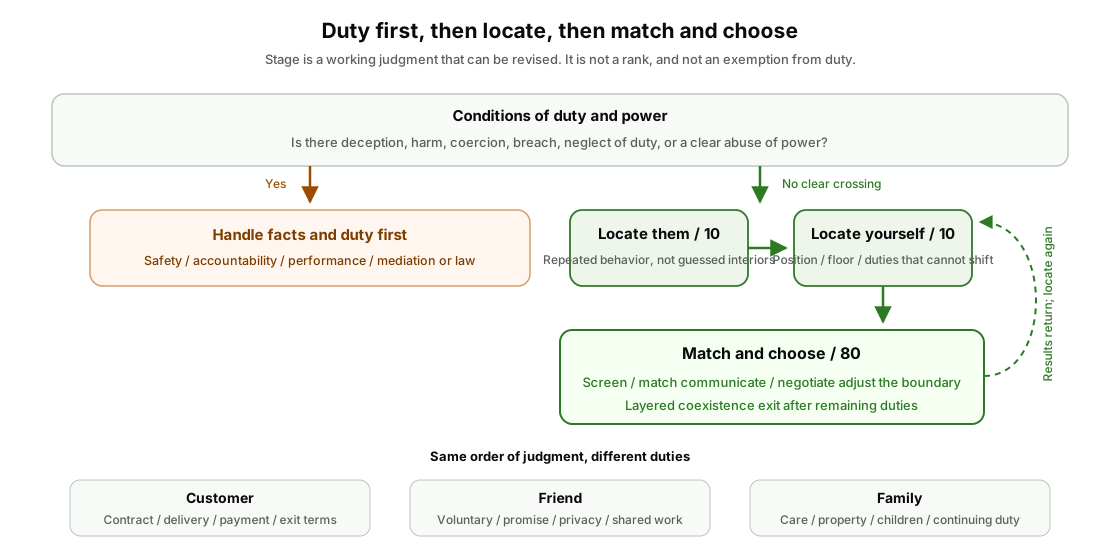
Figure: 10/10/80 marks where the weight of resource goes, not a statistical ratio. Customers, friends, and family share the order of judgment, and are bound by different duties.
5. Negotiation can change an arrangement; it cannot remake a person #
Communication exchanges facts, needs, constraints, and information each side holds. Negotiation handles range, cost, term, duty, and the stop condition. Repair admits an effect already caused, and uses later action to restore trust. Those moves all change the arrangement of a relationship. They do not require that one person be remade as another.
A concrete behavior can become a condition of continuance. A customer needs the definition of acceptance confirmed. A supplier needs delivery made good. A friend needs to stop leaking privacy. People living together need to share care again. Asking that harm stop, that a promise be kept, or that a duty be carried, is management of a boundary. It is not control of thought.
Remodeling the other party points at another arrangement: making a change in core values, character, direction of life, or present duty of living the condition of continuance, while today's time and resource are allocated as if they will change later. If a startup can deliver only after a large customer drops its entire procurement process, the present cooperation has not yet formed. If a friendship can be kept only after one side changes the direction of a life, the present relationship also has no arrangement that can be executed.
People can learn and change. An outsider cannot complete that change in their place. After pooling 64 couple studies and 1,784 parameter estimates, Kanter and colleagues found that both positive and negative communication had a significant but small predictive effect on later relationship quality, and that negative communication was also related to later dissolution. One conversation is not enough to decide the fate of a relationship. Long interaction still accumulates a result (Kanter et al., 2022).
Fentz and Trillingsgaard pooled 12 randomized trials and found that relationship assessment and feedback had a between-group effect of about g = 0.23 on marital functioning, which could be maintained to six months. That small effect is neither "communication is useless" nor "communication necessarily repairs" (Fentz & Trillingsgaard, 2017).
Ntoumanis and colleagues pooled 73 health interventions and found that support for autonomy, and change in autonomous motivation, were related to improved behavior. The overall effect was small to medium, and studies differed widely (Ntoumanis et al., 2020). A health intervention cannot stand for every relationship. Voluntary participation, real feedback, and support of capability still sit in a different mechanism from control and pressure.
A break in cash, a customer leaving, an alert of health, and a legal consequence may expose the cost of an old practice. They cannot give manufacturing a crisis a warrant. Deliberately cutting support, manufacturing dependence, using shame, hiding information, or driving a person into a corner destroys informed choice. The conduct standard Treat People with Honesty has no family exemption and no large-customer exemption.
Manufacturing pain and executing a legitimate consequence also have to be kept apart. Refusing unpaid customization, pursuing a claim under a contract, reporting violence to the police, and stopping a relationship of continuing harm all handle a fact that has already happened. Manufacturing suffering on purpose wraps manipulation as help.
A relationship can raise a need, negotiate a rule, and support a voluntary change. It can also set a consequence on behavior. When a present decision is made, count only capability already shown and promises already kept. After a new change has happened, judge again on the new fact.
6. Customers and business partners: a boundary cannot replace performance #
In Getting Real, published in 2006, Basecamp wrote that every new feature request first received a "no" or a "not now." The team would listen, and would not act at once. Only when the same request kept coming back did it enter a deeper assessment. Even if many people asked, the product direction still sat with the team (37signals, 2006).
Customers raise problems. The team looks for the shared need behind different requests. What is refused is a promise on the spot, and a single customer deciding the product line directly. After Basecamp launched in 2004, it soon had a large number of paying customers. The founders later said that no single contract could decide whether the company lived or died, so the company could bear the cost of refusing an individual demand. Long-term profit and financial health belong to company self-report. 37signals has not published a continuous audited series.
The capital relationship used a similar boundary. Jason Fried and David Heinemeier Hansson have said in public that in 2006 Jeff Bezos bought a small stake from the two founders, that the money did not enter the company, that Bezos had no control, no board seat, and no set term of exit, and that the company continued to operate on customer revenue (37signals, REWORK podcast). Degree of dependence and the terms of governance turned "choose the right people" into a boundary that could be executed.
WeWork and SoftBank are not a customer relationship. They are a relationship between a company and a large investor. The two can be compared with Basecamp only on concentration of dependence, boundary, and governance. They cannot form a like-with-like customer contrast.
SoftBank's founder, Masayoshi Son, told Forbes in 2017 that he had asked Adam Neumann to make the original plan ten times larger, and had on that basis thought the valuation cheap. In January 2019, WeWork announced that related SoftBank investment had taken the company's post-money valuation to $47 billion. The public record confirms a large volume of capital and a clear encouragement of expansion. It does not have evidence that every expansion decision can be booked to SoftBank.
WeWork's prospectus showed 2018 revenue of $1.822 billion and a net loss of $1.927 billion; in the first half of 2019, revenue of $1.535 billion and a net loss of $905 million. As of the end of June 2019, future minimum lease payments were about $47.2 billion. Risk between long fixed leases and shorter membership revenue was disclosed, as were governance, related-party transactions, and control (The We Company, 2019).
On September 24, 2019, Neumann resigned as CEO and remained non-executive chairman. On September 30 the company withdrew its S-1 from the U.S. Securities and Exchange Commission. By the end of March 2020, SoftBank disclosed that its group had invested a cumulative $10.3 billion in WeWork and related entities, with a book value of $2.4 billion; its estimate of WeWork's total equity value had fallen to $2.9 billion. The pandemic affected the later valuation. The failed listing happened before the pandemic. In November 2023 WeWork entered U.S. Chapter 11. In June 2024 the reorganization took effect, and the company continued to operate after cutting about $4 billion of debt.
Long leases, continuing losses, governance, market demand, the capital environment, management decisions, and the pandemic all took part in the result. "SoftBank demanded expansion, therefore WeWork failed" goes beyond the public evidence. "WeWork sat at a lower stage" likewise has no factual basis. What can be compared is only the mechanism of the relationship: before a high dependence forms, the power of the capital, what can be borne, who is responsible for expansion, and the terms of exit all have to be written clearly.
A customer relationship is also bound by a contract. A new customer who does not fit need not be signed. Once signed, deliver under the contract, or change, take responsibility, and terminate under the contract. Under China's Civil Code, for example, Article 509 requires the parties to perform their obligations in full as agreed, and to perform notice, assistance, and confidentiality in good faith. "Different stages" cannot become a reason to deliver less, pay less, or hide a risk.
So screen before a contract is signed. Communicate when demand changes. Negotiate when the range is out of balance. Reduce risk when dependence is too high. Exit under the contract when the conditions cannot be met. Basecamp shows that a boundary can sit with listening. WeWork and SoftBank show that a capital relationship has to be handled together with power and duty.
7. Friends and partners: an exit mechanism is not proof of stage #
The "six gentlemen of Vantone" held several roles at once: friends, founders, managers, and shareholders. A friendship is usually kept by choice. A partnership still has to handle company assets, rights of decision, debt, and the price of exit.
Public materials do not fully agree on the earliest names and years. Global People, from interviews with Feng Lun, records that those who formally began in 1991 were Feng Lun, Yi Xiaodi, Wang Gongquan, Wang Qifu, and Liu Jun, and that Pan Shiyi joined about half a year later. After that the six were called, together, the "six gentlemen of Vantone." The six did not jointly found Vantone on the same day in 1991.
The split was also not an instant decision in one meeting. In the autumn of 1994 the six met at Xishan in Guangxi, and a serious split appeared in the company's direction. Feng Lun has said that between 1994 and 1996 the six discussed, again and again, whether to keep cooperating and how to split. Communication and coordination came before the rule of exit.
Also in 1994, in Los Angeles, Feng Lun described the deadlock to Zhou Qiren. Zhou Qiren suggested that the sides bid in turn: if one side left, how much would the other be willing to pay. After they returned, exit was gradually completed through arrangements of equity and assets. Feng Lun put it as "enter in the jianghu way, exit in the merchant way." By the time he formally separated from Wang Gongquan, the process had already been simplified to "one hand a check, the other a signature" (Global People, 2016).
Leaving operations and a formal exit are also not the same node. Wang Gongquan entered IDG in 1998 and resigned as president of Vantone, then still kept some honorary or related posts; public résumés only end the Vantone-related posts in 2003. Complete public files of the concrete asset and equity arrangements of Liu Jun, Wang Qifu, Yi Xiaodi, and the others are missing.
Later operating results clearly diverged. SOHO China, founded by Pan Shiyi and Zhang Xin, listed in 2007; the annual report disclosed a raise of HK$12.3 billion. Sunshine 100, led by Yi Xiaodi, later listed as well, then defaulted on a dollar bond in 2021. An exit mechanism can handle a partnership deadlock. It cannot guarantee that every new road succeeds.
On the friendship, the public material is only the parties' own accounts. Feng Lun has said the six still meet later, and that several reorganizations did not hurt feelings over money. That is Feng Lun's public statement. It cannot confirm the whole experience for the other five.
Several roles need not advance or retreat together. If a commercial direction cannot be coordinated, bidding, shares, assets, and signatures can be handled first. Whether the friendship continues is left for the parties to decide separately. Layered coexistence here is not a stopgap. It is a separation of roles.
What the public facts show is a split in strategy, a deadlock of governance, a long discussion, and a rule of exit. There is no material that proves the split came from "different stages." An exit mechanism also does not need to judge first who sits at a higher stage. It only needs to keep different choices from dragging the company and the relationship together into an open-ended fight.
8. Family: the relationship can end; the duty cannot be cancelled #
Customers, friends, and family can use the same order of judgment. They cannot use the same rule of duty. A family relationship involves a higher dependence and a larger cost of exit, and it especially affects minor children, members who need care, and the economically weaker party. Dynamic lifecycle management can only adjust expectations, promises, boundaries, and actions. It cannot turn family members into objects to be optimized.
Under China's Civil Code, for example, spouses have a duty of mutual support, and parents jointly bear the duty of raising, educating, and protecting minor children. During a marriage there may also be joint property and joint debt. After a divorce, the relationship between parents and children is not erased, and the interest of the children and the duty of support still have to be handled. A partnership of two people can end. Those duties cannot be cancelled by "different stages."
The public conflict between Dangdang's Li Guoqing and Peggy Yu stacked family, equity, and company governance. U.S. SEC filings confirm that the two were co-founders; the company listed on the New York Stock Exchange on December 8, 2010. In February 2019, Dangdang announced that from January of that year Li Guoqing no longer held any post in the company, remained a shareholder, and that Peggy Yu also served as CEO. The management role had already changed. The relationships of shareholder, spouse, and joint property had not ended at the same time.
In October 2019 the two accused each other on public platforms. The content involved private life, property, equity, and control of the company. Mutual accusations that have not been independently verified are not used as fact. What can be confirmed is that several roles had already entered the same dispute, and that "the relationship drifted" cannot cover it.
Two incidents involving the company seals happened in 2020. On April 26, Li Guoqing led people into Dangdang's offices and took the seals and other items. An investigation result made public in June said that that act had not been found illegal; Dangdang said it would apply for administrative reconsideration. In the second incident, on July 7, Chaoyang police reported that Li and others had disturbed the company's ordinary work by forcing a lock and restricting other people's personal freedom, and that four people were then administratively detained. Conduct already found unlawful cannot be covered by "no right or wrong."
On June 13, 2025, Li Guoqing said in public that he and Peggy Yu had dissolved the marriage in 2023, that the two had recently reached a final settlement on the division of property, and that Peggy Yu would continue to lead Dangdang. The public record has no judgment, docket number, settlement text, or independent confirmation from Peggy Yu of the final arrangement. The nodes of divorce and settlement are therefore attributed only as Li Guoqing's public statement.
After Dangdang went private there is no continuous, independent, comparable operating series. The public material cannot compute the effect of the conflict on revenue, profit, or enterprise value, and cannot attribute an operating result to a family dispute.
Once family, equity, company governance, property, and duty of conduct are stacked, they have to be handled separately: a safety problem enters a safety process, unlawful conduct bears a legal consequence, control of the company is resolved under the governance documents, property and marriage enter negotiation or a judicial process, and the duties of children and of care continue. A stage view cannot close any one of those processes.
The same view therefore yields different actions. A customer who does not match need not be signed to a new contract. Partners who cannot continue can design an equity exit. Family members who end a shared life may still jointly bear, for a long time, the duties of raising and of care. The deeper the relationship, the more a role that can be left has to be kept apart from a duty that cannot be escaped.
9. Limited energy has to go into a named action #
People say a relationship "takes a lot of heart." In ordinary speech that only names limited attention, emotion, and the energy of tending a relationship. It is not a fourth limiting resource, and not a new name for judgment. Money, time, and judgment still belong to three different layers of analysis.
A customer conflict, family care, and the repair of a friendship occupy the same calendar, and they also affect one another's energy. That drain has no common unit, and no ROI formula is built for it. It only says that a relationship is not a costless background. Sitting in vagueness, guessing again and again, and waiting for a change that has not been promised, also have to be paid in time and energy.
Limited does not mean that only screening and exit remain. If information is incomplete, arrange communication. If a rule does not fit, propose a change. If roles conflict, handle friend and partner, spouse and shareholder, customer and investor, as separate roles. If a boundary is crossed again and again, execute a consequence. If the relationship will not continue, still settle the contract, the property, the care, or the other remaining duty.
A judgment of stage also has to accept a test of time. Incompatible today does not mean incompatible forever. Settled today does not guarantee that it will still fit after the environment changes. After a new fact appears, the parties can negotiate again. After conditions change, contact can also be restored. A future that has not happened cannot stand in for a reality already seen.
The old practice that has to be replaced is using remodeling of the other party in place of screening and negotiation. The new order is to handle duty first, then locate both sides from behavior; what can be talked goes into negotiation; what cannot be accepted becomes a boundary; different roles are handled apart; and, when needed, remaining duties are met and then there is an exit. Screening and recognition are still core moves. They have to be used together with communication, negotiation, repair, and adjustment.
The four fields of people, time, product, and relationships are now open. The next step enters the organization as the fifth field: put these judgments into a first round of ninety-day practice, and settle them as standards, context, and organizational action.
What to Do Monday Morning (principal-leader view) #
Pick one relationship that currently takes the most attention. Do not audit every customer, friend, and family member at once.
- Write the roles and the duties first. Is the other party a customer, an investor, a friend, a partner, a spouse, a parent, or someone who shares care? One relationship can hold several roles. Write separately the contracts already signed, the promises made, the duties of care, and the floor of safety that cannot be crossed. If there is deception, harm, coercion, a material breach, or neglect of duty, handle the fact and the duty first. Do not enter a judgment of "no right or wrong."
- Split facts and interpretation into two columns. On the left write only observable choices, outlays, promises, and pace of action from the recent stretch of time. On the right write your interpretation of those facts. Anything that appears only on the right cannot be taken, by itself, as the other party's position.
- Locate yourself. Write your own constraints, ranking of value, capacity to bear risk, life or role duties, and pace of action, then set a floor for the present arrangement and a longest date of review.
- Check the important matters. Do not ask whether two people are "on the same frequency." List only three to five matters that jointly affect the result. Mark which already match, which can be negotiated, which need a boundary adjusted, and which can no longer continue.
- Choose only one next step. It can be raising a need, confirming information, talking one rule, narrowing the range of cooperation, separating roles, arranging mediation, or exiting after remaining duties have been met. Write an owner, a date, and an observable result for it.
- Agree a review. When the date arrives, look only at what happened: whether the promise was kept, whether risk fell, whether both sides kept executing the agreement. If the new result supports the original judgment, keep it. If it overturns the original judgment, locate again.
Where violence, coercion, the interest of a minor, material property, a legal dispute, or personal safety is involved, this list cannot replace a lawyer, professional mediation, psychological and social support, or emergency help. Stage is a way of looking at a relationship. It is not a license to handle every relationship.
Chapter Acceptance Self-Check (against chapter acceptance standards) #
- Claim restatable in one sentence ✓: "no right or wrong" only where there is no clear deception, harm, coercion, breach, or neglect; stage is a limited view, not the default cause of an ending; duty first, then locate from behavior, check compatibility of important matters, then choose among several actions.
- Nine-section spine and whiteboard figure ✓: less contact only proves less contact → stage is position not rank → compatibility of important matters → 10/10/80 with duty-and-power gate → negotiation is not remodeling → customers/capital → friends/partners → family duties → everyday drain, not a fourth resource. Figure is the relationship-decision loop; gears are out.
- Evidence caliber ✓: Wrzus 2013; Vieth, Rothman & Simpson 2022; Arránz Becker 2013; From et al. 2025; Kanter 2022; Fentz & Trillingsgaard 2017 g = 0.23; Ntoumanis 2020. Basecamp from Getting Real 2006 and the REWORK podcast; long profit as self-report. WeWork/SoftBank from S-1, withdrawal, SoftBank FY2019, Chapter 11 2023–2024; not a like-with-like customer pair and not a single cause. Vantone from Global People 2016; Pan joined later; 1994–1996 discussion; Wang Gongquan 1998/2003; SOHO HK$12.3 billion; Sunshine 100 2021 default; split not booked to stage. Dangdang from SEC 2010, 2019 announcement, two 2020 seal incidents kept apart, 2025 Li statement only; no stage ranking of the couple.
- Case contract ✓: Basecamp for boundary plus listening; WeWork/SoftBank for dependence, power, and exit terms; Vantone for an exit rule in a partnership deadlock; Dangdang for stacked family, equity, governance, and law, and for the title's limit. Author's friend psychology, sales-meeting interiors, gears, operating capacity as a fourth resource, Naval as method, metamorphosis/chasm on people, "he'll get it," only screen-or-exit, and "everyone succeeded after Vantone" are out.
- Action menu ✓: screen, communicate, negotiate, repair, adjust a boundary, layered coexistence, exit after remaining duties; not only select or exit.
- Chapter boundary ✓: ninety-day assembly waits for Chapter 14; the everyday drain of a relationship is not a new limiting resource; China's Civil Code as an example of duty, not a comparative-law treatise.
- Fluency ✓: rewritten in English voice from the Chinese authority; current prose-standard.