
Rewrite the DNA · Living edition
Chapter 8The Interference Method: Narrow the Other Party's Options
Interference Method = analyze user consensus (10%) + find suitable scenarios (10%) + create consensus (80%). It lets the other party see only the solution you want them to choose; consensus is always manufactured—if you do not manufacture it, you hand the manufacturing rights to your opponent.
1. Two Noodle Shops #
You are on a business trip in an unfamiliar city. Nine in the evening, hungry. Two noodle shops across the street have their lights on: one sign reads "Lanzhou Beef Noodles," the other "Old Wang's Noodle House." Your knowledge of both is exactly equal—zero. Which one did you walk into?
Most people walk into the first. You have never eaten there and never read a review, and the owner may not be from Lanzhou at all. Yet the word "Lanzhou" lets this shop borrow a collective quality consensus that a region spent more than a century building. Your judgment that "this bowl is probably not bad" was finished before you pushed the door. Liuzhou river-snail rice noodles, Sichuan hot pot, Chaoshan beef kway teow run the same mechanism. A single shop needs years to earn trust from zero; hanging a place name is zero-cost access to a ready-made trust network. Place names are the catering industry's oldest Interference Method: one word, borrowing a century of trust.
No one lied to you, and no one pushed an ad, but your options narrowed from two to one, and the other shop barely existed in your eyes. The Clarity Method works inward and expands your own options. The Interference Method works outward, narrowing the other party's options: among N solutions, they see only the one you want them to choose. Great organizations are hard on both hands. Organizations hard on only one either have good products no one believes, or tell beautiful stories they cannot deliver.
2. Consensus Is Manufactured #
Good products speak for themselves. That belief was even true in its own era, so it is worth saying clearly how it expired. In the age of expensive execution, making a decent product was itself a filter: the threshold kept most players out, shelves were not crowded, and good products really could be seen without pushing. Execution zeroing removed that premise. The threshold for making products collapsed along with execution, and similar products now flood the market at ten or a hundred times past density—while on the other side of the shelf, users' total attention did not increase by a minute.
This structure had a textbook verdict long ago. In 1971 Herbert Simon wrote in Designing Organizations for an Information-Rich World that information consumes the receiver's attention, and therefore the abundance of information creates a poverty of attention (Simon, 1971). The same scissors cut twice. Inside the organization, abundance of execution exposes poverty of judgment. Outside, abundance of products creates poverty of attention. Attention is the limiting resource on the demand side of the business market—this time applied to your customers. Scarce resources must be allocated, and users allocate attention by filtering through ready-made consensus, because comparing products one by one is too expensive. At those two noodle shops, you finished all your "research" before you pushed the door.
Products never speak. What speaks for them is consensus—the density of the judgment "this place is reliable" among the target population. When products were scarce and consensus competition was mild, that weakness was not fatal. In a glut, attention filters out the product without consensus first, ahead of the worst product. Consensus never grows on its own. The place-name consensus behind Lanzhou beef noodles was fed by generations of practitioners holding quality steady, and what looks like "word of mouth fermenting naturally" breaks down into designed initial touchpoints. There is no consensus vacuum in the market. If you do not manufacture consensus about yourself, your rivals, price-comparison platforms, and random bad reviews will manufacture it for you. Giving up on manufacturing consensus hands over the steering wheel.
The Interference Method has three steps, dual to the Clarity Method: analyze user consensus (10%) + find suitable scenarios (10%) + create consensus (80%). Step one: what judgments already live in the other person's head—what they default to believing, what they guard against, what words they use for this category. Step two: pick the scene where the same sentence lands—press conference, racetrack, a friend's dinner table; credibility differs by orders of magnitude. Step three takes eighty percent, because consensus, like an optimal solution, must be trial-manufactured: try comparison objects, measurement points, narrative angles; let market feedback kill weak versions. The whole motion is a funnel: options in the other party's eyes enter at N, pass three valves, and one exits.
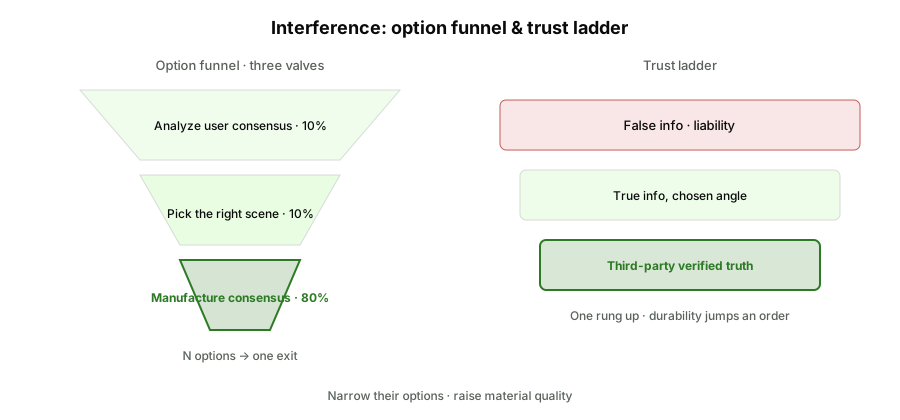
Figure: left, narrow their options; right, material climbs from false information to third-party verification.
Step one is most often pretended done. Analyzing user consensus does not mean asking users what they want. It means excavating judgments that already exist in the other party's mind. They are not a blank page waiting for your pen; they sit across from you carrying a full set of ready-made consensus. Category words: what they call this kind of thing. You call yourself an "AI-native organization consultant"; the word they retrieve may be "management training," pulling up a decade of vigilance toward management training. Price anchor: what this kind of thing "should" cost in their mind. Chung Xue Gao shattered that anchor. Trust entry: how many times this category has burned them, and whose recommendation preceded the last time they paid. None of the three live in your conference room. They live in ten years of consumption and being fooled. One plain acceptance test for this step: can you predict their rebuttal after your first sentence? If not, you are still talking to an imaginary user, and the eighty percent you manufacture next will precisely answer a question no one asked.
3. Ethical Line: Two Methods, Only One Allowed #
Manufacturing consensus has only two operational paths, and they sit very close together. That is the danger of the Interference Method.
Method one: selectively display true information. You choose what to show first, at which measurement point, against what comparison, in what scenario—but the information itself must be true and retestable. Method two: manufacture false information. Invent facts that do not exist, forge data, hide critical flaws—that is deception.
Short-term effects of the two methods are nearly indistinguishable, which is exactly the danger: under performance pressure, organizations naturally slide toward method two—one word in the copy away. See what that word looks like: change "13% thinner than same-size models" to "world's thinnest"; change "lab-environment data" to "field-tested data"; change "some user feedback" to "users unanimously praise." Each edit hits harder and moves one step toward false information. The slide needs no malice—only three consecutive rounds of "this reads better for distribution." By the time someone asks "can we deliver on this sentence?" it is often already on the poster. To block that slope, we set Treat People with Honesty as a behavioral standard. The causal direction is isomorphic to how Judge by Value was born. Methodology came first; the boundary grew because the method required it. When the Interference Method reaches the "manufacture" step, a hard boundary must grow immediately, or the methodology drives the organization into a ditch. Behavioral standards are forced out by methodology, and that is why they beat "values on the wall."
Three hard boundaries. Narrowing options is not withholding information: you may choose which face to show; you may not hide facts the other party needs for a correct decision. Manufactured consensus must be delivered: everything you make them believe must hold at delivery; consensus you cannot deliver must not be manufactured. Acceptance is no regret afterward: if, after delivery, they repurchase and refer, Interference Method is an asset; if they feel cheated, you have left the method and entered deception.
Deception profits once from information asymmetry; Interference Method compounds trust over time. Selective display can repeat ten thousand times; false information starts a countdown the first time you use it.
4. The Second Valve: Scenario—the Most Skipped Ten Percent #
Among the three steps, the middle one is skipped most often. Analyzing consensus sounds like research; creating consensus sounds like execution—someone in the organization owns each. "Find suitable scenarios" sits between them and sounds soft. It is actually the multiplier for the steps before and after: pick the wrong scene and the other two are zero times anything.
Mechanically, scenario decides three things. Who is speaking: the same fact from you is promotion; from a third party it is evidence. At the extreme, the racetrack timer speaks for you—not the brand. When to speak: consensus can only be planted in a mind that is looking for an answer; if they did not sit down with a question, your answer is noise. Which path it travels in on: in a cold conversation with no referral chain, a seller describing their own product is naturally discounted as "seller statement"; relay the same words through a trusted link and the discount vanishes. If any one of the three fails, the quality of the fact itself cannot make it up.
I paid tuition on this for more than half a year. I dissected my financing sample earlier—the empiricist ledger there. Read the same specimen through the Interference Method and you see two fractures. From October 2025 I refused financial advisors and built my own investor outreach, including face-to-face meetings with well-known partners at top-tier funds. I booked all the silence under "investors are conservative."
Who was speaking: founder to strangers, entirely seller statement, no third-party material underneath. When I spoke: the company's stage and market temperature were not in that fund type's window, so however smooth my narrative, it could not answer what they were actually verifying at that moment. Which path in: cold outreach, no referral chain. All three missed.
The FA I took on in May 2026 ran the three steps. First a tiered map of investors—what each stage verifies, what logic each institution type uses—analyze consensus. Then match investors on that map and connect at the right moment—choose scenario. Then polish the business plan and roadshow with me, aligning narrative to their verification checklist—create consensus. Same company, nearly the same facts; feedback density completely different. Between them, only whether someone seriously turned the three valves.
This specimen also leaves a reverse operating rule: when the scenario is wrong, the best Interference Method is silence. Telling the right person the narrative at the wrong time costs more than not telling: their first-version consensus becomes "this company is not ready yet," and revising consensus always costs an order of magnitude more than manufacturing it. Waiting for the right scenario is the ten percent itself.
5. Credibility Ladder for Consensus Materials #
Materials for manufacturing consensus stack into a ladder by credibility: false information (liability) < true information from a self-chosen angle < true information verified by a third party. Each rung up raises cost one level and durability by an order of magnitude.
Outside the ladder is a zero-cost form: borrow existing consensus—the opening place name. Collateral usually comes in three kinds: origin (Lanzhou, Chaoshan—borrow a region's quality consensus), category ("we are the Y of X"—borrow a mature category's cognitive frame), person (celebrity endorsement, institutional rating—borrow a third party's stored credibility). Borrowed consensus is a loan, not a gift. Every shop hanging a "Lanzhou" sign draws on the whole category's credit line; one botched pot and the whole category shares the bad debt. Local standards for river-snail rice noodles read differently from a lending lens: place-name consensus is a credit pool shared by the whole category; local standards install risk control on that pool. Once "what kind of noodles may carry this name" is written in black and white, borrowers stop overdrawing each other. When you borrow consensus, ask yourself the same question in reverse: can I deliver what this name promises? If not, you borrowed a bad review withdrawn in advance.
July 27, 2016, Xiaomi Notebook Air launch—the famous line "thinner than a penny." The true part is airtight: 13.3-inch body at 14.8 mm, 13% thinner and 5% lighter than the thickest point on a same-size MacBook Air; anyone with calipers can retest every number. The comparison object was a penny, which everyone has in a pocket, and the measurement point was your thinnest against their thickest. Not one lie, and every measurement point chosen for you. That is the textbook mid-ladder: full demonstration of method one.
The same launch is also this method's boundary sample. "Thinner than a coin" used the diameter of a coin standing on edge. The angle pushed too hard against common sense, and the internet mocked "redefining thickness." Once a selective-display angle breaks the common-sense floor, the audience takes over the narrative. You lose not only this round of spread but the long discount that "what you say must be heard at a discount." Angles may be chosen, but choose so the audience feels played and you are half a step from method two.
March 29, 2026, WSBK World Superbike Championship, Portimão. Zhangxue Motorcycle, a Chinese brand two years old and in only its second race, won both WorldSSP races; the 820RR-RS crossed the line nearly four seconds ahead, breaking a decades-long European, Japanese, and American monopoly. Race results, lap times, rules—even the measurement points were not chosen by the brand. Underneath is hard capability: an in-house 818.8 cc inline triple, above fifteen thousand rpm, 153.6 hp. Founder Zhang Xue, apprentice mechanic turned builder, live-streamed after-sales himself after winning. Personality narrative stacked on hard capability. True information retestable in a third-party scenario is the top of the credibility ladder; no launch copy can buy it. That sequence is where the next specimen flips.
6. Loser Sample: A Nine-Thousand-Yuan Fine, a Brand's Bill #
Chung Xue Gao, like Xiaomi a domestic-brand marketing specimen, is the cleanest contrast: same toolbox, both boundaries breached.
In 2019 Shanghai Huangpu and Jiading market supervision administrations penalized the brand twice—products advertised "not a drop of water added" listed drinking water on the ingredient label; "special-grade red grapes" were bulk/first grade; claimed award-winning cheese and "baby-safe chew sticks" could not be substantiated. Premium narrative pushed price consensus to sixty-six yuan per stick while real product experience could not carry it. Summer 2022, users coined their own word: "ice-cream assassin." After that every narrative was written by them; the brand went from namer to named. Outcome: wage arrears, founder under high-consumption restrictions, the brand name hollow. In 2024 the founder live-streamed to repay debt—selling sweet potatoes. From sixty-six-yuan premium narrative to sweet potatoes in a live room, every segment of that arc is on record.
The first breach was manufacturing false information. The second was manufacturing consensus that could not be delivered. When users start naming you in their own words, you lose Interference Method initiative. It is the most complete pricing process for "manufacturing consensus you cannot deliver."
The bill structure is worth remembering: two administrative penalties totaling nine thousand yuan. Nine thousand. The regulator's interest rate is posted, and startlingly low; deception's real high rate never comes from regulators but from users. Regulators punish behavior; users punish the brand—the former bills per incident, the latter settles once. Put Chung Xue Gao beside Zhangxue Motorcycle: one manufactured consensus with narrative that could not be delivered; one delivered consensus on a third-party track then layered narrative. Both have founder personality stories; order differed—one lived, one died.
7. Product Is the Interference Method's Largest Arena #
Interference Method has a deeper form than marketing: narrowing options for the user is product value itself.
When Jobs returned in 1997, Apple's catalog had bloated until even employees could not explain model differences. The Performa line alone spawned dozens of near-identical SKUs; dealers sold from comparison charts; users stood at shelves doing closed-book exams. Soon after, Jobs drew a two-by-two on the whiteboard: ordinary users and pro users as rows, desktop and portable as columns—one product per cell, everything outside the grid cut. For users, the judgment had been "which of these dozens fits me?"—a question with no standard answer. After the four-cell strategy it narrowed to two: "Am I an ordinary or pro user? Desktop or portable?" Answer those and one SKU remains. Option overload is cost to the user, not sincerity. Narrow to the solution you are most confident you can deliver and their decision cost and your delivery risk fall together. The line against concealment is still the hard boundary: cut redundant options, not key information; every product left in the four cells was the one Apple was most confident it could deliver then. That cut was Interference Method in product form.
Product also hides Interference Method's largest-scale application: facing the full adoption curve—whom to manufacture consensus for first, which end of the curve to borrow from, how to iterate forward to the frontier. The full path of "consensus reverse iteration" gets its own chapter later; the general craft lands here first.
I wrote this book and put it on Regenic.ai for free public reading using the Interference Method. Naming it Rewrite the DNA and naming the sole bottleneck "the last scarcity" narrows your vocabulary for "AI organizational transformation." Information true, angle mine—I ran the three hard boundaries on myself first. Moore's Crossing the Chasm is the ultimate demonstration of this shape: thirty years later investors and entrepreneurs worldwide still describe the early-market death zone only in words he invented. The ultimate form of Interference Method is an industry describing the problem only in your words. At that point you define the language competition happens in.
Regenic.ai is this experiment's public bench: the text keeps publishing cases, tools, revision history, and company practice; whether communication promises hold, readers can trace back through versions and outcomes. If this book's judgment is that the price of acquiring knowledge is going to zero, I zero the text price first and leave what cannot be given away: whether readers can use these standards to rewrite their own organizations. This site is accepted by two things: whether these words enter industry daily language, and whether any company completes one round of retestable change with them.
8. Boundaries of the Claim #
Three.
First, Interference Method is not manipulation—the line is written in behavioral standards. This is the book's most questioned word, so answer it directly. Manipulation means making the other party choose against their interest. Interference Method acceptance is the opposite—consensus delivered, no regret afterward, repurchase and referral. The three hard boundaries (do not hide facts needed for a correct decision, do not manufacture undeliverable consensus, accept by no regret afterward) are the bright line between Interference Method and manipulation. Cross it and the name is deception—Chung Xue Gao's bill showed what interest rate that liability carries. This line does not rely on practitioners' moral will; it relies on being written as behavioral standard, entering the standards engine, being checked, accepted, and iterated.
Second, Interference Method runs at every organizational interface inward and outward. Hiring manufactures consensus that "this company is worth joining"; fundraising manufactures "this track needs me"; internal reporting manufactures "this plan deserves resources." The only difference is whether anyone does it consciously. A company that treats Interference Method as a marketing trick installs a steering wheel in one department only.
Third, sample quality, stated plainly. Xiaomi and Chung Xue Gao fact chains have public primary materials (launch records, penalty documents)—solid quality; Zhangxue Motorcycle race results and product specs come from public reporting, retestable; my financing sample is self-report—hear it at a self-report discount. Two data gaps marked plainly: no quantitative study found yet on place-name category trust premium (conversion gap between named and unnamed); long-run return gap between "selective display vs false information" currently has only Chung Xue Gao as negative specimen—larger same-industry contrast sits on the data-needs list. Until gaps close, this chapter's claim strength stays at mechanism derivation plus positive-negative pairing.
What to Do Monday Morning (principal-leader view) #
Pick the target you most want to win (major customer, key hire, next-round investor). Spend one hour on three questions—one per valve:
- What is their current consensus (10%): Write three default judgments they hold about your category—what they believe, what they guard against, what words they use for the category. If you cannot write them, ask; if you cannot ask, do not meet yet.
- Which scenario will they actually hear (10%): Launch, case site, referral dinner through an old customer, third-party review. Same fact, different scenario—credibility differs by orders of magnitude. Pick the highest-credibility one even if it is slowest.
- Which single solution should they see (80%): Compress your plan into one retestable comparison—what is your "14.8 mm vs penny"? Then hard-boundary self-check: in this comparison, is there any fact they need for a correct decision that I did not say? Can this consensus be delivered one hundred percent at handoff? Fail either question—go change the product, not the copy.
Individuals and teams can use the same self-check line: résumé and performance review are the highest-frequency Interference Method scenes for individuals—you may show your brightest face, you may not claim undeliverable capability; the interviewer's "no regret afterward" is your probation.
Chapter Acceptance Self-Check (against chapter acceptance standards) #
- Claim restatable in one sentence ✓, and core-claim inference (judgment scarce → having others adopt your judgment equally scarce, second production line).
- Whiteboard framework figure ✓ (option funnel three valves + consensus-material credibility ladder inserted).
- External comparisons and data ✓: positive place-name category (mechanism), Xiaomi (textbook + boundary warning), Zhangxue Motorcycle (ladder top), Jobs four-cell strategy, Simon 1971 attention poverty; loser Chung Xue Gao (penalty documents verified); internal financing sample Interference Method side (self-report quality declared); two data gaps on place-name trust premium and long-run return gap marked plainly.
- Eighteen quotable-line candidates ✓.
- "What to Do Monday Morning" three questions + personal note ✓.
- Fluency ✓: whole-sentence rewriting and English breath under current prose-standard.