
Rewrite the DNA · Living edition
Chapter 9The Consensus Engine: How Shared Context Is Created
The only output of an AI-native organization that cannot be outsourced is consensus: humans are responsible for consensus, and AI is responsible for everything else. When outsiders start using your language and judgment standards, consensus escalates into cultural spillover.
1. Working for a Slightly Different Company #
In 2016, Administrative Science Quarterly published a study: two scholars conducted 76 in-depth interviews to reconstruct how Nokia lost the smartphone war from 2005 to 2010. They found neither technical incompetence nor strategic blindness. Nokia's engineers had long seen the direction of touch screens and ecosystems. What they found was a conveyor belt of fear.
Top management feared the outside world—Apple's offensive, shareholders' patience—so they hammered the middle layer for results while refusing to lay out the full threat. Middle management feared the inside—superiors' anger, peer competition—so they reported only good news, filtering bad news a little at every layer. The two fears linked end to end. The Nokia top executives saw was a company that did not exist. Its operating-system progress looked fine, its technical capability looked sufficient, it just needed to move faster. Each layer of management worked for a slightly different company, and the real company was dying outside everyone's field of view.
Middle management was not ignorant. Symbian's true state and the real gap with the iPhone were close to an open secret in the middle of the organization. Managers in the interviews admitted they stayed deliberately optimistic in reports because, in that organization, people who brought bad news were seen as passive and unambitious, and tempers at the top were intimidating (both points come from the study's interview records). Top management was not idle either. They kept pushing down for faster results, but pressure intensified the filter: the harder the push, the more middle managers reported only the kind of message that could pause the pressure. People at every level were rationally protecting themselves, and together they killed the company. The process needs no villain, only a structure that makes honesty more expensive than optimism.
What reached the top after layer upon layer of beautification was fake context. That, not Apple, is what defeated Nokia.
The parts already built—the standards engine, Clarity Method, Interference Method—combine into one complete machine called the consensus engine. What it produces is exactly what Nokia lacked most before its death: unified context.
2. The Only Output an Organization Cannot Outsource #
A company's output is its product. That sentence no longer holds. AI handles product execution; AI optimizes market launch; code, copy, reports, and customer service all sit on the zero list. Peel away everything that can be outsourced to AI, and one kernel remains: consensus on "how we judge"—what counts as good, what not to do, which standards apply when conflicts arise. No model can produce this for you, because it is not information. It is a group's shared belief in the same set of judgments.
What the consensus engine produces is shared belief in the same judgment standards. Everyone raising a hand on every decision is a decision mode, and often the slowest. On the contrary, the thicker the consensus, the faster single-point decisions can be: when standards and context are unified, one person's judgment is likely what others would choose—no alignment meeting needed, because alignment already happened. Consensus lets everyone decide alone while still pointing the same direction. That also answers the worry that unification kills diversity: what unifies is the ruler. With a shared ruler, different answers become comparable and debate converges instead of diverging; without a shared ruler, a century of argument is just two coordinate systems passing each other. Humans are responsible for consensus, AI is responsible for everything else. Build consensus well and product is a by-product; let consensus rot and AI will use perfect execution to scale rotten consensus. The root of the abundance paradox sits here.
The consensus engine assembly diagram is the book's second main figure. The standards engine is the core component; the Clarity Method and Interference Method are two production lines; the consensus engine is the assembled whole; cultural spillover is the external effect of the whole running continuously. There is one machine, assembled layer by layer. Inside the whole, three functions stack: the standards engine solidifies judgment, turning a few people's tacit judgments into testable, iterable provisions; the consensus engine copies judgment, letting different members act independently on the same standards inside shared context; cultural spillover spreads judgment—once judgments keep producing results, people outside the organization begin using them on their own.
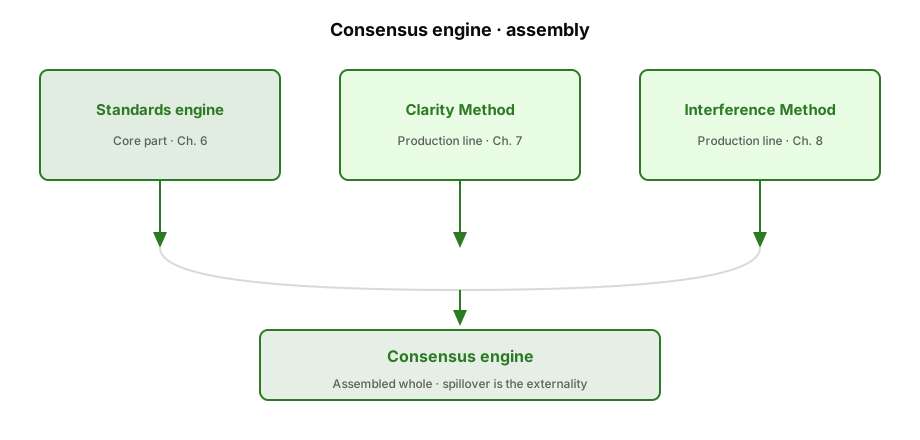
Figure: the book's second main figure. One machine assembled in layers—not parallel machines.
Great organizations need, and need only, two capabilities: unified judgment standards and unified context. The judgment-standards half has already been covered; what still needs depth is the other half: context. It is easier to overlook than standards because it looks like a by-product of daily communication. Nokia already demonstrated the price of neglecting it.
3. A First-Hand Textbook on Context: Context, not Control #
How is unified context manufactured? The most complete first-hand textbook comes from Zhang Yiming's 2017 talk at Source Code Capital's Code Meeting, Being a CEO Means Avoiding Rational Conceit.
He defined two words as tightly as an engineering spec. Context: the information set required for a decision, including what the principles are, what the market environment is, what the industry structure is, what the priorities are, what level must be reached, and business and financial data. Control: committees, directives, decomposition and rollup, process, approval. Then the principle: "We prefer 'Context, not Control' solutions"—ample Context, minimal Control; everyone holds complete contextual information and makes business decisions; managers intervene only when necessary.
The reflex arc most worth copying into the standards library: "When a problem appears, the habit is to ask first whether Context is insufficient—not to add Control." When progress stalls, ask first: was industry context, business data, or past failure cases not shared? Place that reflex beside Nokia and you see two machines running in opposite directions. Nokia's information filtered through fear—the higher it rose, the falser it got—so the organization paid for the gap with more Control (committees, approvals, pressure), and Control bred new fear. ByteDance's information spread by decision need—the more transparent the context, the less control required; judgment delegated to wherever information was richest. Control is interest paid on non-unified context—and it compounds.
Zhang Yiming also observed that some people "use information asymmetry to demonstrate their own value." That is information hoarding: keep context in your hands and become the mandatory gate. In old organizations that was individually rational survival strategy; in an AI-native organization it is sand in the machine, because AI's output ceiling is set by the context you feed it. One person hoarding context lowers the output ceiling of every colleague and every AI at once.
He also answered at the tooling layer: an internal tools team of nearly a hundred people; a self-built OKR system wired to internal IM so new hires can access internal materials on day one. In his words, this is "building the company as a product." Unified context comes from infrastructure that makes obtaining context easier than hoarding it.
4. Three Workshops of the Machine: Meetings, Documents, Review #
Unified context sounds like culture. On the ground it is three concrete workshops. Every company has all three; the difference is whether they operate them as parts of the consensus engine.
Meetings are the consensus assembly line. Most company meetings produce two things: emotion and to-do lists. Meetings inside the consensus engine may produce only one thing: an update to judgment—a new standard, a revision to a standard, or a hypothesis awaiting test. Acceptance rules are hard: input must be evidence (data, something runnable, users' exact words), not opinion; output must be writable into the standards library—if it cannot be written in, the meeting might as well not have happened. Measure your standing meetings with that ruler and most companies find more than half spinning idle: neither closing judgment gaps nor producing judgment updates, only aligning the same people's time into a ritual of busyness.
Documents are consensus storage. The engineering meaning of "building the company as a product" is that verbal consensus decays. Verbal consensus is not consensus. Verbal transmission decays once per hop; by the fifth person it is already a different judgment. Standards are how judgment is stored; decision context must be documented too—otherwise every newcomer pieces together a worldview by "asking around," and what they piece together is inevitably a slightly different company. Nokia's disease begins on day one of onboarding. MD Anderson has an echo here: the last straw that broke a sixty-million-dollar project was a medical-records system Watson could not read after the organization swapped systems. People and machines are equal on this point: people who never receive unified context and machines that read the wrong format produce judgments with no essential difference.
Review is the consensus correction loop. Standards going live starts the hypothesis. Review feeds execution results back into standards: verified, solidify; falsified, revise. Without this loop the consensus engine degenerates into a dogma printer—more documents, wider drift from reality, every page stamped "consensus reached." Nokia had meetings and documents; what it lacked was the loop's most fragile component: the right of bad news to pass through. Of the three workshops, this one breaks first, because it is the only component that requires someone to pay first: the bearer of bad news bets the organization will not punish honesty. The principal leader has one maintenance mode for this component: publicly and observably reward the first person to report bad news. The loop also has a personal minimum version: three questions a day—cheaper than any review meeting.
5. A Machine Mid-Retrofit: Transn #
ByteDance is a near-native sample; most readers face another situation: a company that has run twenty years—how do you install the consensus engine inside old workshops? Transn's mechanism design is worth reading line by line.
The first move is a role for consensus on the org chart: a Chief AI Officer (CAIO), explicitly split from the CIO—the CIO keeps systems running; the CAIO makes the business smarter. One manages information pipes; one manages judgment density. The second move is a decision body for consensus: an AI Native decision committee so transformation judgments do not scatter across departments. The third is a hard rule: no runnable demo, no meeting. It forces meeting input from opinion up to evidence—opinions argue; a running demo does not. The fourth, the most intricate, is the energy gold mechanism: internal AI apps accumulate returns only when colleagues actually use them and are satisfied. Judgment rights go to users; decision rights go to data; AI adoption shifts from administrative order to market behavior. Together, four moves make a miniature consensus engine: the committee solidifies judgment; the demo rule filters moisture out of context; energy gold manufactures consensus on "which tool works" from usage data, not rank. Effect data for this mechanism set have no third-party verification yet—I cite only the mechanism itself; every design logic can be borrowed directly.
Founder He Enpei has two lines that work as this retrofit machine's nameplate. One explains why install the machine instead of training individuals: "Rather than wait for employees to become AI masters, let the organization grow AI capability." Whether capability lives in the organization or in the person is the line between organizational judgment and personal judgment—and the only feasible path for retrofitting an old company: you cannot wait for every employee, but you can change the machine first. The other adds a human version to execution zeroing: "The future world has only two kinds of people—those who produce tokens, and those who use tokens to create greater value." The former stands on the execution layer, on the zero list; the latter stands on the judgment layer, commanding execution through consensus. A translation company that ran twenty years and arrived here is more convincing than any native company's manifesto. It was not thought through—it was chased there by the zero curve.
6. Spillover: When Others Start Thinking in Your Words #
When the machine keeps running, something odd happens: consensus crosses the organizational boundary and begins reproducing outside.
The three museum samples have appeared before; this chapter looks only at their spillover face. Duan Yongping's influence circle is the cleanest observation: the word benfen ("duty" / staying in one's proper lane) did not stay at BBK—it entered the value ordering and decision language of OPPO, vivo, and Pinduoduo; a generation of entrepreneurs uses it to judge their own companies. Musk's enterprise cluster shows cross-company replication: first principles, rapid iteration, extreme goals repeat across SpaceX, Tesla, and several other companies, becoming a shared reasoning craft for tens of thousands of engineers. The scaled limit sample is the Communist Party of China: judgment standards compressed into transmissible organizational language; ultra-large-scale decentralized execution supported by shared context; practice feedback entering correction mechanisms. My research on this sample stops at organizational mechanism—dimensions beyond mechanism are outside this book's scope.
The three samples jointly define cultural spillover's acceptance line: everyone starts thinking in your language. Brand awareness measures attention; cultural spillover measures diffusion of judgment standards—the former can be bought, the latter can only be earned through consistently correct judgment. Moore's word chasm, which ruled venture language for thirty years, is the personal-scale version of the same thing. Spillover is therefore the ultimate gauge of the consensus engine: if internal judgments do not keep producing results, outsiders will not borrow your words. Cultural spillover is a result, not a project. Companies that treat it as a communications project get visibility, not spillover.
Spillover sends back three very concrete things. Talent self-selection: when benfen becomes industry language, candidates who share it walk toward the BBK ecosystem; those who do not, walk around it. Recruiting's first filter is outsourced to culture itself, at zero cost. Customers with pre-installed consensus: when customers describe needs in your framework, the first two steps of the Interference Method—analyze consensus, find the scene—are already done for you; of the three valves, spillover keeps the first open for you. Pricing power of language: when the industry discusses problems in your words, every competitor must enter your coordinate system before arguing difference. After Moore coined chasm, every early-stage company had to answer "how do you cross the chasm"—whether they liked the question or not. All three share one shape: compound interest. Once spillover starts, it lowers the cost of every consensus you manufacture afterward.
7. Boundaries of the Claim #
Three.
First, "cannot be outsourced" is a priority, not a ban. Humans responsible for consensus, AI for everything else, means how scarce human time should be allocated: the largest share should go to consensus production—raising standards, aligning context, testing judgments—not to execution AI can do. Product and technology still matter. When you can put your best people on only one thing, put them on consensus.
Second, unified context is the information set required for a decision—spread by decision need, not indiscriminate disclosure. Salary privacy, compliance red lines, unannounced M&A—none belong in the "decision-required" scope. The acceptance test for unified context is: people making the same decision see the same fact set. The whole company does not need to see every fact.
Third, sample quality—stated honestly. Nokia has academic backing from 76 interviews—it is this chapter's load-bearing wall. Zhang Yiming's talk is first-hand full text, but ByteDance's subsequent practice effects are company-caliber only. Transn cites mechanism only; effects lack third-party verification. Duan Yongping circle failure-and-correction lists and Musk cluster bilateral data—debts owed earlier remain owed here. One known gap remains: quantitative evidence for collaborative tooling (e.g., Feishu-class products) on context unification is not yet available; this chapter's tooling discussion rests only on ByteDance's first-hand account of self-built tools.
What to Do Monday Morning (principal-leader view) #
Three gauges, one hour to read:
- Read RPM: Pull up the company's most important document—strategy, core standards, or customer definition. Check two numbers: when was it last updated? Ask five people from different departments at random—how many can restate its key points without looking anything up? No update in six months means the standards engine stopped; recall below thirty percent means the consensus engine stopped.
- Check for sand: Find the three most common "you have to ask so-and-so" information nodes. Ask one question: is this division of responsibility, or information hoarding? Simple test: how long would it take to document that information? If the answer is within an hour and it still is not written, someone is using information asymmetry to demonstrate value. Document all three this week and watch who objects.
- Watch spillover: Search whether customers, candidates, or peers actively use vocabulary and judgment frames you invented—do candidates speak your internal shorthand in interviews? Do customers describe problems in your framework when stating needs? Finding none is not shameful; it honestly tells you the machine is still building its first revolution.
Individuals and teams can also adopt a personal version of Zhang Yiming's reflex arc: when a subordinate or AI delivers something wrong, ask first "Was the context I gave enough?" then "Is their capability the issue?" Reverse the order and you will replace people for every problem that should have been solved with documents.
Chapter Acceptance Self-Check (against chapter acceptance standards) #
- Claim restatable in one sentence ✓, and core-claim inference (judgment scarce → shared belief in judgment is the only organizational output that cannot be outsourced).
- Whiteboard framework figure ✓ (consensus engine assembly figure inserted—the book's second main figure).
- External comparisons and data ✓: loser Nokia (ASQ 76-interview first-hand study); positive S5b Zhang Yiming Context, not Control (2017 talk, first-hand full text) + Transn four mechanisms (mechanism only) + // spillover three museums (caliber and debts stated honestly); MD Anderson as context echo, not repeated load-bearing.
- Seventeen quotable-line candidates ✓.
- "What to Do Monday Morning" three gauges + personal note ✓.
- Fluency ✓: whole-sentence rewriting and English breath under current prose-standard.